"I know it's not much," she said. "But even if it's just for an hour, I feel like in that hour, I could be doing laundry, or prepping dinner, or helping Junior with homework, or getting him signed up for summer camps, or taking him to the park."
"Can't he do some of this himself? Like, how far away is this park?"
"A half a mile."
"A half a mile?"
"Yeah."
"How old is he again?"
"[redacted]"
"Wouldn't he like to do some of that himself anyway?"
"Yeah, he actually did that last weekend, and he couldn't stop smiling. It's the first time he was that far away from us without parental supervision."
Look, I've worked with many parents, and there are many good reasons not to train, including, but not limited to, time constraints, financial limitations, child age, etc. However, none of those are the most common reasons parents struggle; they even quit training and racing. Well, what makes them give it up? Guilt.
Guilt? Yes, guilt. Guilt that they're not doing enough to ensure that their child has a sufficiently rich, stimulating, and varied childhood so that they grow up to be, if not someone famous or rich, someone sufficiently advantaged and accomplished to secure their birthright—an upper-middle-class lifestyle. And how do parents ensure that happens? By spending every waking moment actively trying to further that aim and feeling terrible about themselves if they're not.
What I'd like to say about parent guilt is that it's worthless*. Kids would be better off now and in the long run if they had more independence and parents claimed (and defended) a life outside them. In that space, parents open up for themselves; they can fit in more than enough training to be much faster than they'd imagine. All they have to do is drop the guilt.
Before I wade further into this, I'd like to say that that statement is not 100% true in every conceivable parenting situation. If you've got a newborn, you're probably screwed. If putting food on the table is an issue, buying a new Lauf, no matter how affordable it is with its excellent direct-to-market model, isn't for you. Maybe your spouse only ever tolerated your racing habit and pretended it'd be OK if you kept doing it and is ready to call the lawyers if they see you putting on lycra again. There are exceptions, of course, but - no offense - you're probably not one of them.
How do you rid yourself of this guilt? It's easy. Remember what our friend Robert Frost said—the only way out is through. You've got to attack the parenting belief that's eliciting guilt head-on, bury it, and move on with your life.
Helicopters Always Crash
Many parents, especially moms, commit a classic error the Stoics articulated thousands of years ago—failing to distinguish between what is within their control and what is outside their control.
Parents now think they are directly in control of their children's outcomes. When this belief intersects with pathological technologies like social media and deep-seated psychological impulses—such as the desire to live vicariously through their children—it gives rise to what we collectively term "helicopter parenting,' otherwise known as parenting that's far too involved in the minutiae of their children, to the detriment not just of their happiness, but of their maturity and fulfillment. And yet, what do most parents do? The opposite.
They feel guilty if they're not spending every spare moment not grinding out a paycheck and keeping the kid(s) fed, running them through hooked on phonics, memorizing multiplication tables, learning piano, or generally engaged in something that promotes an eventual flourishing, upper-class lifestyle.
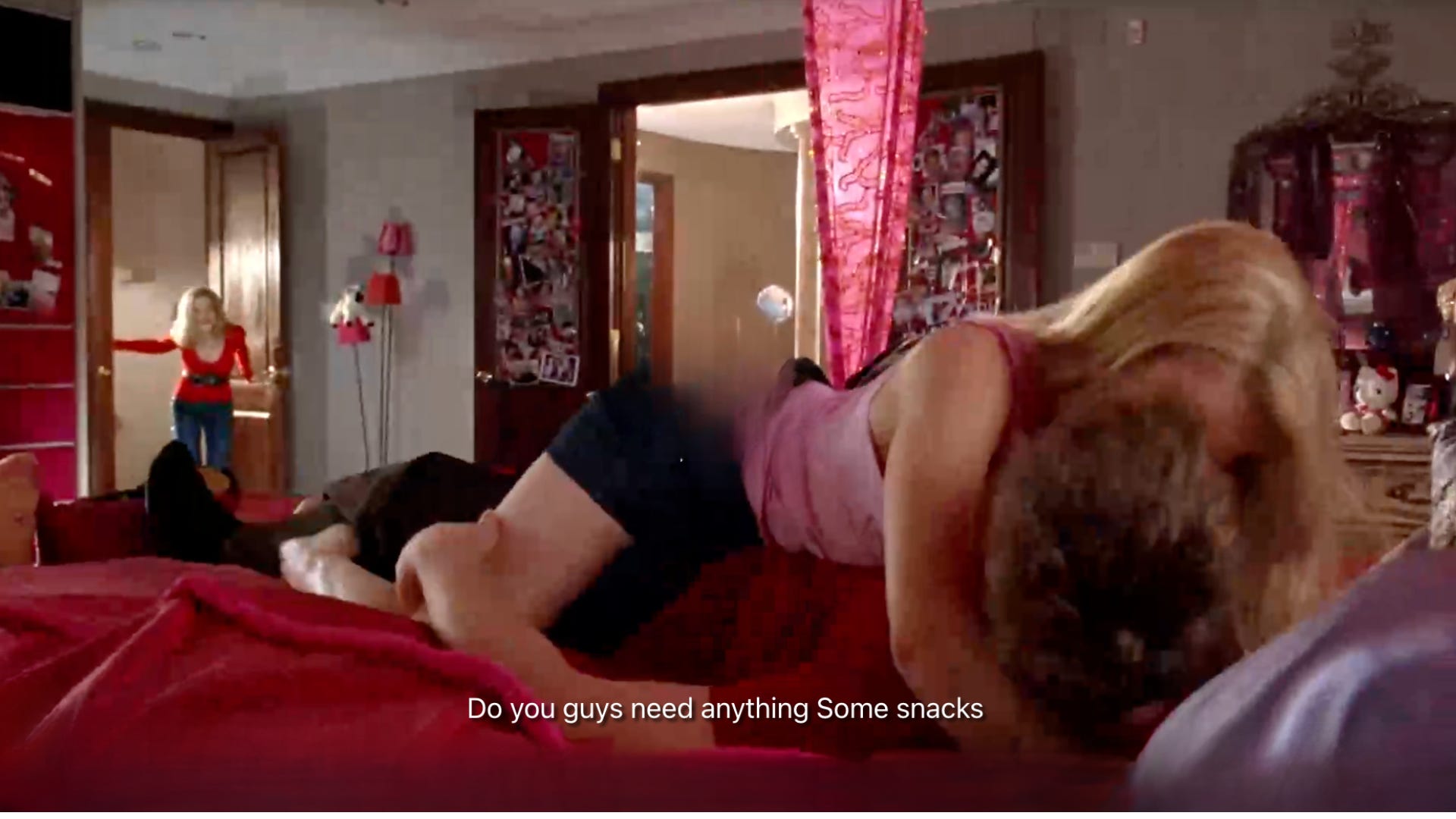
Except, to quote one of the better lines from Wedding Crashers, "We are suffocating them." Never in the history of parenting have we put more pressure on parents to involve themselves in their kids' lives, and never have parents been more willing to throw away the keys to the helicopter and make their kids lives their lives.
Who is to blame? Social media. It nurtured an entire generation into believing that their lives were movies other people wanted to watch.
Kids don't need you as much as you think they do. Unless the parent is neglectful and checked out, it's probable that kids would immensely benefit from giving them space to play independently of their Big Brother parents, stop viewing their parents as butlers, and even, god forbid, make mistakes or pick up recoverable injuries!
Challenging parents to give their children more autonomy represents a massive change of belief that has immediate, tangible consequences for both parties - kids grow up, and parents get away so they can finally be selfish and train.
Doesn't that make the parent selfish?
Ah, there's that word that triggers parents so much - selfish. As a parent, nothing you do is supposed to be selfish, and if you are selfish, you're only supposed to be selfish so you can do more for others, not because you get anything from it.
Well, that's bullshit. Not only do I think you should be selfish because it'll make you happier, and that's a worthy goal in and of itself, but being a selfish parent is ironically necessary if you don't want your brat to be an exploitative, self-serving, self-important shit in adulthood.
The Giving Tree Was Wrong - Love Isn't a Stump
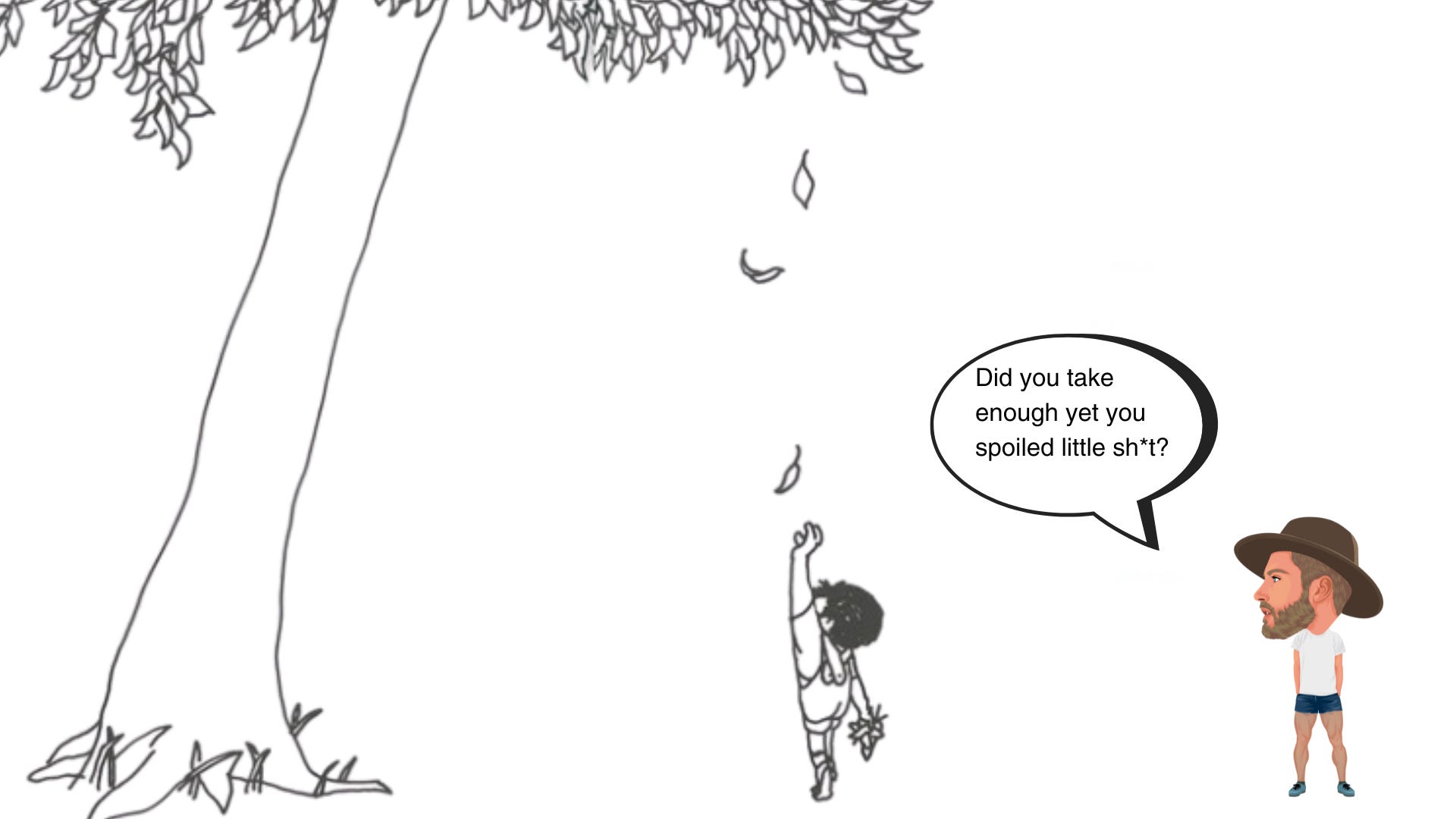
Remember the Giving Tree? It's about a boy and a tree. The tree gives to the boy throughout his life until it's just a stump, and the boy gives nothing back in return other than his presence when it suits him.
On the final page, the boy (now an old man) sits on the tree stump, and the tree is happy.
Some people think that's the perfect illustration of love and something parents should aspire to.
Me? I think those people are insane, and the book is psychotic.
You see, the Giving Tree gave too much and did a disservice to the boy by allowing him to take unconditionally without reciprocity.
At no point in the book, even as an old man, does the boy do anything for the tree. The final scene doesn't seem as triumphant as it is sad, with the old man looking dejectedly into the horizon while sitting on the Giving Tree's remaining stump, filled with vague, unspecified regret (the boy had a wife and family that didn't seem to go well) that was caused because the very thing he was sitting on allowed him to become what he was sitting on.
And so it is with parents who spend eighteen years or more giving everything to their kids. Not only does this rob those kids of the chance to build their agency through independence, but it also centers the child in the parents' lives and distorts the child's sense of importance.
Millennials are the first generation to grow up like this - participation trophies, Ritalin, therapy, selfies, etc - and everything else boomers like to drag their kids for. But as insidious as those things might be, the worst consequence is that millennials internalized what Boomers believed - that they weren't links in a chain, but the end of it.
All the Me Me Me, the therapy, the social media accounts, the prevailing wisdom that of all the things you can do to fuck up your life when you're young, the worst is having kids because then you're not free to do whatever you want whenever you want with whoever you want and they're only something you should consider when conditions are perfect, and you're established and done all you wanted to do in life because they moment they take their first sip of air your life is over.
It's no wonder that if you were brought up on that shit, it'd make you think you're the end of the chain, that the point of life is a never-ending pursuit of more for me.
And what is the result? Look around. It looks to me like people really struggle to find meaning if all they're doing is adding another highlight to their reel.
I realize this is a hell of a conclusion, but yes, you can do your part to break the chain of raising half-formed, self-absorbed dipshits with one simple trick - train and race your bike. The time you spend not on them will help them develop into the type of adults the world needs.