
I'm sure the organizers of the Tour de Bloom are lovely people, but I hate their guts.
Why? They're killing my coaching business.
The day after the Tour de Bloom ended, I received a text message from one athlete reminding me of bruising high school breakups: "Can we talk?"
Shortly after that, I received another bruising text message from another athlete at the event announcing their impending departure after the stage race -FML.
Tour de Bloom? More like Tour de Doom.
I was in the desert at the time, in a location where AT&T offered one grudging bar of coverage, so I couldn't properly shoot back something long and heartfelt, snarky and dismissive, or cryptic and emoji-filled—I could only return a read receipt, which no doubt contributed to my disastrous coaching churn rate.
Why the sudden exodus?
The race didn't go well for either of them, and whether I like it or not, an athlete's 'bad' result is ALWAYS 100% the coach's fault, so I got deservedly canned.
Please consider subscribing so I can afford to feed my kids.
Comparison is the thief of joy, Cucks Us All
Your greatest moments, the most impressive things you've accomplished in your life, were a lie.
Why? Because they were a function of who showed up, and if you were being measured against the best, your mediocrity would be so apparent as to be humiliating.
That hurt to type, but it is the thin ice we all skate on. Humans are social creatures. We inevitably (even in Stalin's Russia) construct hierarchies based upon the different social groups we join based upon some combination of power, merit, and guile. Our position within those hierarchies directly affects how we feel about ourselves. The lower you are in a hierarchy (or several hierarchies!), the worse you feel about yourself, and vice versa.
Interestingly, our relative position compared to people outside our immediate proximity doesn't comfort us in the least. For example, if you're a millionaire, live in a millionaire neighborhood, but are the poorest in the neighborhood, you're not going to feel great. Never mind that you're better off than not just about everyone in the wealthiest country in the richest time in the history of the world - f**king Steve just bought a Rivian and his family is going to Hawaii for Spring break while you barbecue discount meats at a local KOA in your used Sprinter Van.
And so it is with bike racing. Every 'good' result you've ever had has been a function of who has shown up in the category and the distance you've chosen to compete. You might finish a race just in time to see the overall winner stepping onto the podium's top step and think, 'I must be great to be king,' but that's precisely the wrong thing to consider. What you should be thinking is 'What a tool! Are they smiling because they beat a few local scrubs? If anyone with any real talent showed up, they wouldn't be anywhere near the podium!"
I grant you that this is a bit of a 'black pill' truth, but if you force yourself to be honest with yourself, most, if not all, comparative happiness you derive externally is primarily a function of carefully selecting the conditions that give your ego a chance to get off. It's remarkable the lengths to which people will go to carve out a niche discipline or category that confirms their egos dogged insistence that they, even at the ripe old ages of 40s or 50s, were somehow wronged and overlooked by a pro team and if things had just lined up they too could sport jersey's from long defunct 'pro' teams and tell cheryl all about it at the bar.
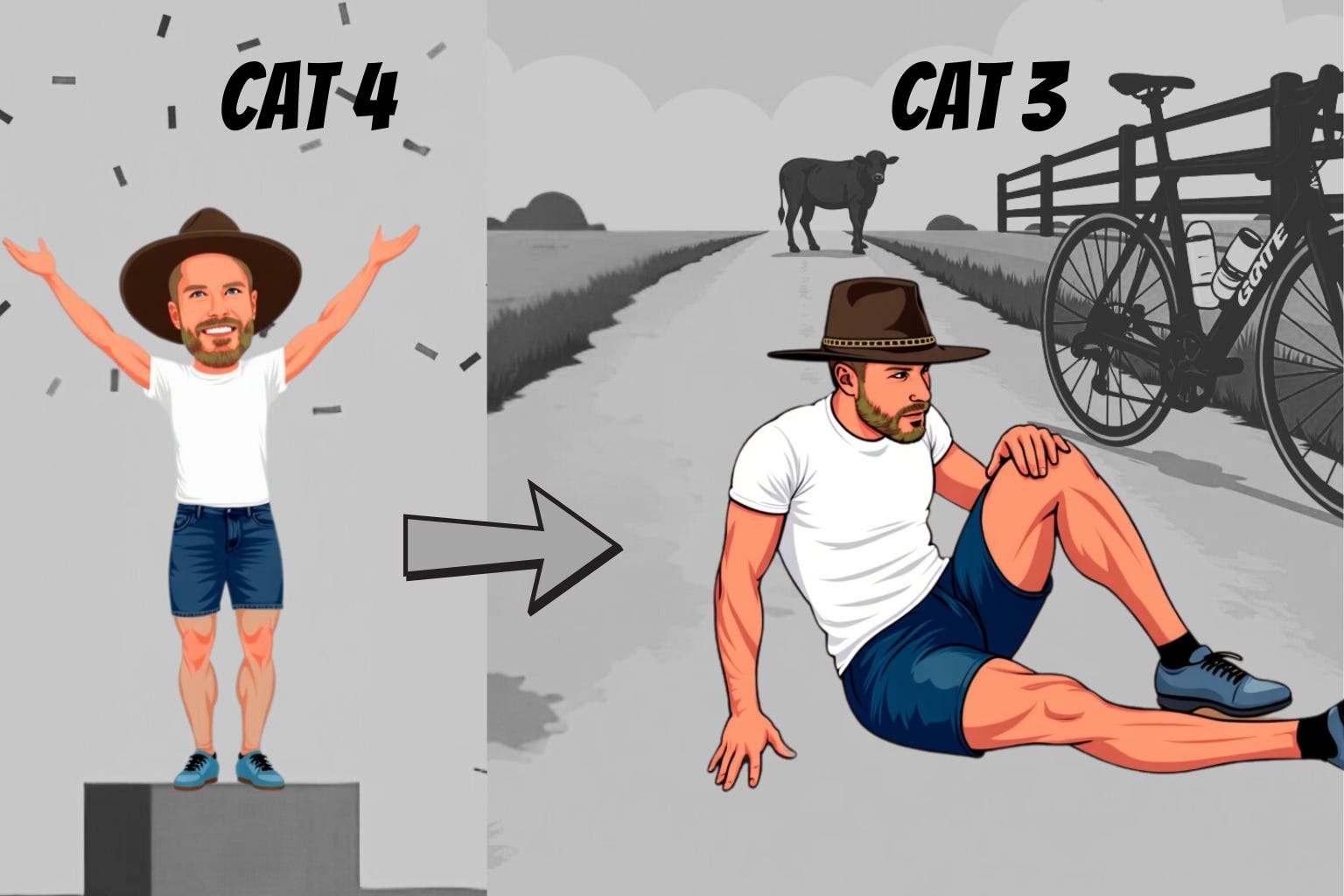
Category Irony
There's a cruel irony in cycling in that the better you get, the higher you climb various hierarchies or categories, the greater the chances of getting your shit kicked in.
For example, let's say you're a real hitter in the Cat 4s. You podium in most races. So you upgrade to 3s after casually triumphing in nearly every race you enter, and, while you expect stiffer competition in the 3s, figure your unrecognized god-given talents won't dim much in the modest lights of Category 3.
The gun goes off, and you get dropped within a few laps or the first 15 miles. Oh, you didn't see that coming! You chase for miles, never regain contact, and maybe finish, but most likely, with your head held low, you DNF.
Last week, by contrast, you had already finished your much shorter race distance in the CAT 4s, on the top step of the podium, of course, and were deciding what words remained in the English language to describe yet another racing triumph.
Now? You slink back to your car, hopefully you don't run into one of your old Cat 4 colleagues you abandoned because you're tired of effortlessly lapping them. The world grays, and you call your significant other, report that you'll be home early, and no, you don't want to talk about it.
Your ride uploads automatically to Strava and TrainingPeaks, and you see several automatic medals signifying a personal best pop up across several important and meaningful durations, but you are so furious that you rage-quit the app and almost throw your phone out the window.
You were as good as or better than ever, but you've never felt worse about this stupid hobby. But this is your reward! You legit earned the upgrade. You were so good that you were arguably sandbagging, so you changed fields. You got yourself into this. You wanted to see what you could do because you like competing, so this is the next logical step. This is what you wanted. Right? Rightttt???
Maybe You Don't Want to Know How Good You Are
I'm not committed to that statement, but in the past few years, one of the best things I've stumbled upon with my athletes is encouraging them to:
Pick shorter distances.
Pick reasonable categories
Frame success in relation to themselves.
The third point is nearly impossible. If I could really convince people to do that, arguably, they wouldn't even need to race. I can remind athletes that they're progresssing or hitting benchmarks until I give myself an asthma flare up, but I'm working with humans, not robots, and when they sign up for a race at least the wild eyed part of them doesn't give an F about what makes sense, they've put in their ten hours a week of the world's scientifically proven superior training zone, sweet spot, and they'll be damned if they don't surprise everyone and just walk away from the field.
When that gets pulled back, it's only a matter of time until I get the telltale 'Can we talk?' chat.
So what do I suggest? Just follow the three ideas above?
I actually don't think that's necessary. What helps the most is cultivating a consistent awareness of how you're manipulating reality to make yourself feel better. Because if you do that, the cold, hard fact that no matter what you do, you still couldn't get near Pogcar's chamois for a minute while he rides tempo doesn't cut so deep. Or that the bowling league you won isn't that special because no one bowls in your county. Or that school you graduated from with honors was not exactly most people's first choice.
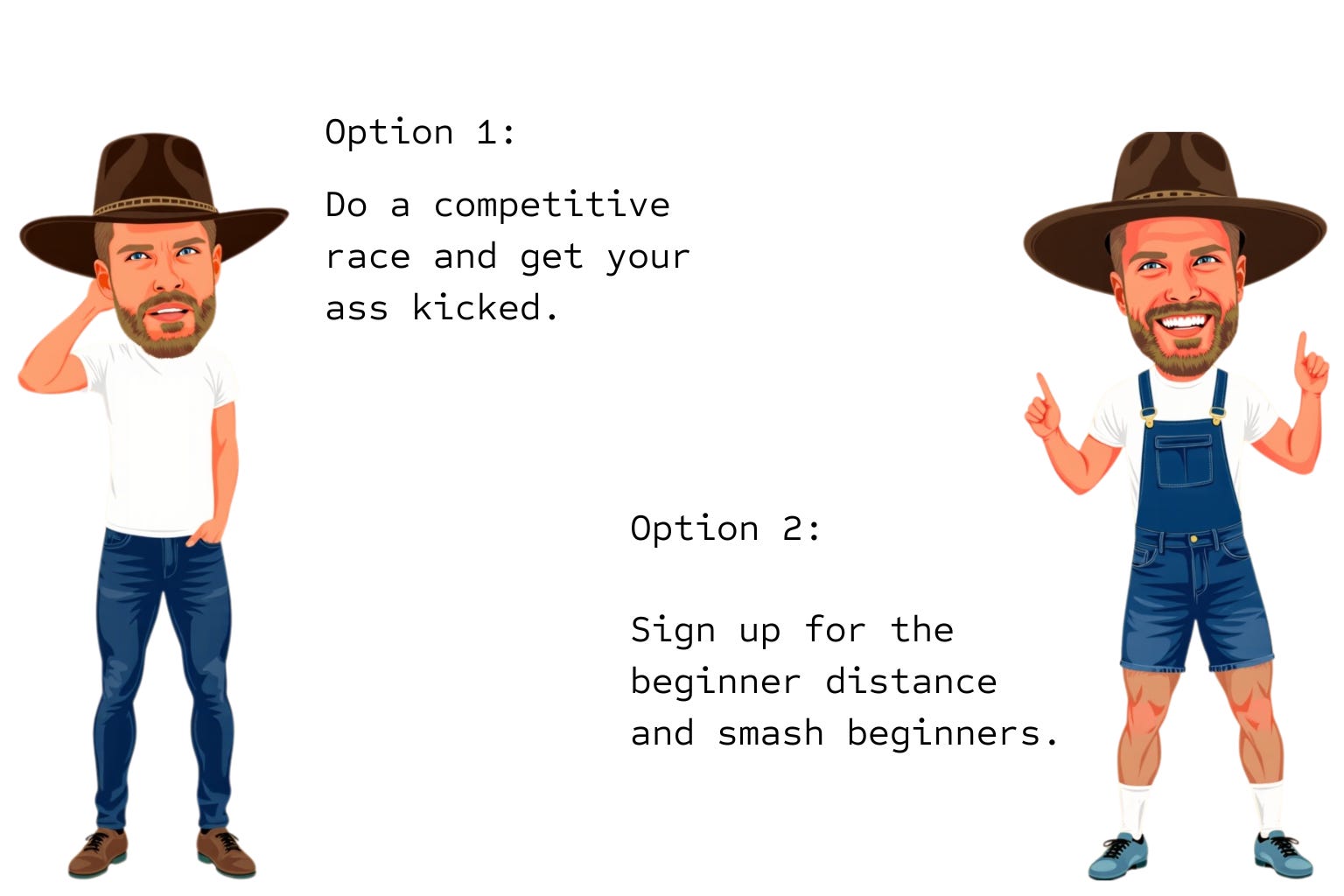
Are You Choosing Conditions That Serve Your Delusions?
I realize I'm not making a popular point here, but I'm coming around to the idea that the second most important point of athletic pursuits is carefully choosing conditions that increase your happiness odds - NOT 'being the best you could be' or 'seeing how good you are'. That sentiment looks great on a poster, but in practise spending all your precious spare time effectively punishing yourself and seeking out trying competitions to see how you measure up and mostly feeling bad about yourself is a great way to burn out and resent the sport, like my athletes did, if you set aside that the terrible instruction they received.
If that sounds cynical and at odds with the spirit of competitions, consider that in every other domain of your life, you don't continually seek out confirmation of your mediocrity. If you're a CPA, you don't go to other companies and try to out-CPA their CPAs in CPA competitions - at best, you do your job well enough that your company gives you a raise. In love, if you have a significant other, you don't date them and spend your spare time searching for that fractionally more attractive and compatible person that would maybe justify a switch, unless you're unwell. In almost any other domain in life, you generally do whatever you're doing to a standard that barely allows you to look yourself in the mirror and then go back to doomscrolling and sipping Miller Lites - you don't seek out ego-destroying reference points.
Please, for the love of God, share this so I get famous someday.
The Clock Stops When You Do
I allude to this often, but as long as training and racing are mostly externally driven, a clock begins silently counting down in the background, eventually terminating in rage and property destruction.
You see, even if you win the race, in your moment of triumph, you've already planted the seeds to your own destruction because you've just raised the standard of what you can constitute a win. It doesn't take a rocket surgeon to understand that this logic of constantly increasing the threshold of accomplishment will quickly place the chances of accomplishment well beyond your reach, which actually makes sense since most endurance athletes are driven to train and suffer so hard to compensate for something that more or less boils down to 'You're not good enough', but I'm not a shrink and you're not in therapy, that's what all the riding is for.
This is avoidable in two ways:
Only (for the most part), measure yourself against yourself.
Be process, not results-driven.
You could squeeze those suggestions out of an eighth-grade motivational speaker, but notice I framed those suggestions as avoidable, not advisable. Of course, you want to measure yourself externally! You're human. Nothing feels better than beating your competition by minutes and having their significant others stare at you as you cross the line, considering making a significant lifestyle change and jumping ship to you. As long as you're winning, life is good.
Confused? Don't be. My takeaway is super simple and extremely helpful: whatever you're doing, OWN it.
Are you measuring yourself externally? Great! Don't get butthurt when you get lapped. As Dylan Johnson said in a recent Bonk Bros episode:
Cycling is funny, because no matter how fast you are, everyone but ONE person has to deal with the fact that they're second best to someone.
Are you measuring yourself internally? Neat. You'll never be as fast as you could be if you're only training in your own little world. Humans outsource the problem of sanity to other people - the feedback you receive when you do something strange keeps you in line. In racing, your position on the result sheet is a corrective to training in a vacuum.
You can’t win either way because, regardless of whether you redeem your training and racing time externally or internally, so long as it’s only about furthering yourself, your joy will be limited, and you will eventually be crushed by despair and no matter how many Miller Lites you drink the sadness will not go away.