This whole volume thing, the dumb, unavoidable logic of the table, kind of feels like a provocation, doesn't it? When you look at that chart and mentally compare the suggestion to where you fall within the training category, it's hard not to think, "If I just HTFU and trained as much as the category above me, I'd be as fast as I secretly hope."
Yeah, maybe you would. But what the chart isn't saying is that for every category you go up in terms of training, the more your life has to change to accommodate it. For Ayahuasca riders, cycling is a side quest and barely a hobby. For Podium riders, cycling is their life ( 😬).
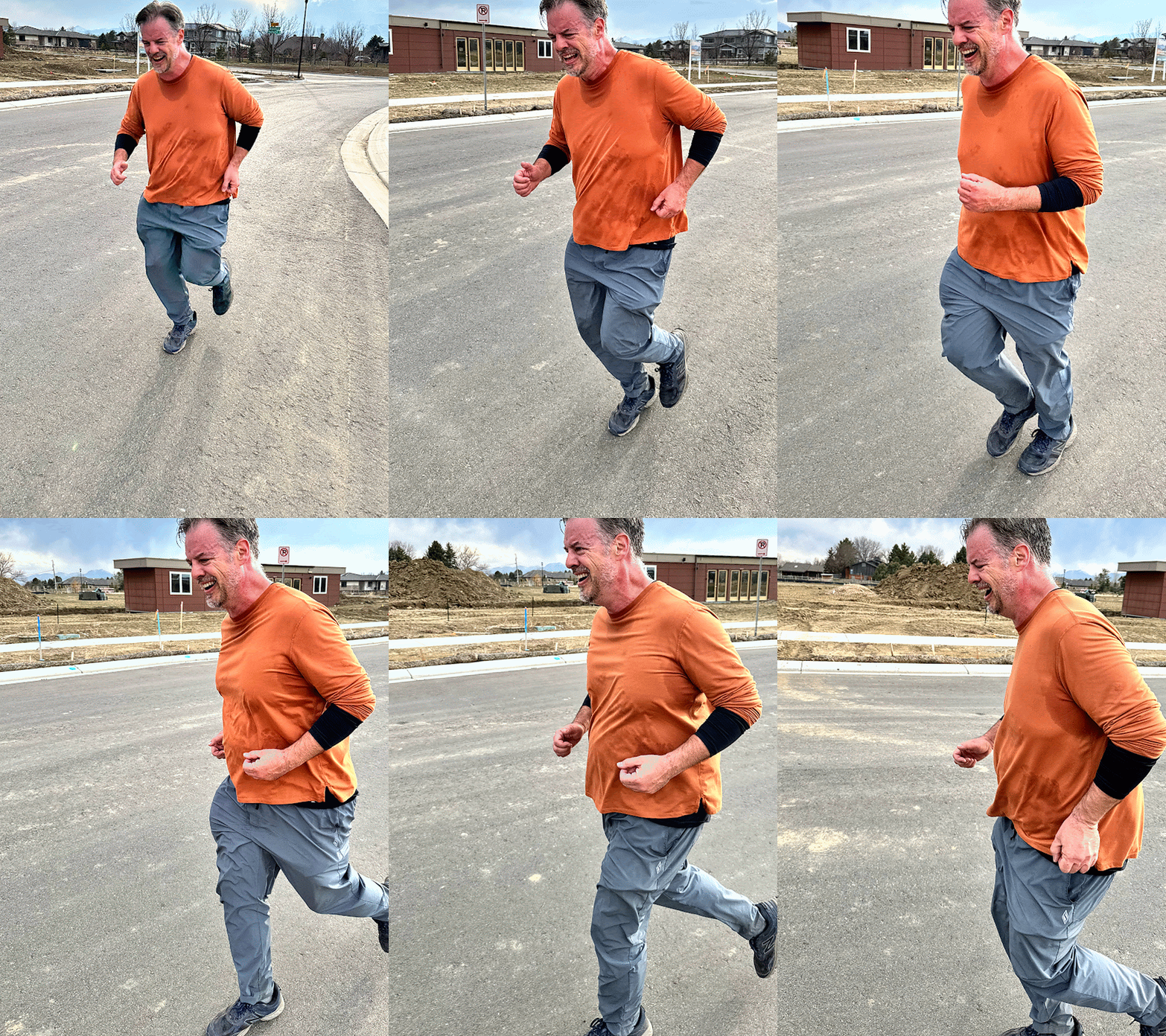
HTFU= 🍆🤚🏻
But that's not what I'm here to talk to you about today. I'd like to draw your attention to the impulse of many cyclists to reflexively reach for the concept of 'HTFU.' If you're unfamiliar, HTFU means 'Harden the F**k Up' and originates from a website called the Velominati. This website lists the 'simple truths of cycling etiquette,' a quasi-religious institution that fetishizes suffering and overplays the necessity of abiding by sartorial standards agreed on by MAMIL(Middle-Aged Men In Lycra) dickheads to other noobs.
Some stuck, some didn't, but as far as I know, HTFU is the most widespread and widely held rule that escaped their incestuous cycling circle jerk into the popular culture and can be heard or thought about on group rides worldwide.
Here's something you've never heard before- suffering just to suffer is masturbation. What I mean by that is that suffering is not the goal of cycling - going fast is. To go fast (or improve), you have to suffer, but suffering itself is not the goal, which is where so many cyclists go wrong. Suffering is only valuable to the extent that it makes you faster.

The Wall Experiment
Do this: run headfirst into a wall several times before you start a training ride. Does it hurt yet? Good! Congratulations - you're suffering!
Now, do your workout. How did it go? Did running headfirst into a wall make you ride faster?
It didn't? That's weird because there's no question that you suffered more than you would if you hadn't.
Huh! It's almost like suffering for its own sake doesn't make you faster. When the pain becomes the goal of the workout, it comes at the expense of the goal of the workout, which is to produce the best performance adaptation possible from a superior stress signal.
Thanks for reading Slow, Mid, 38s! This post is public so feel free to share it.
Training is about applying a specific stress to produce a specific adaptation. When you suffer to suffer, the workout stress becomes less specific. If the workout stress is less specific, the adaptation is less specific, i.e., you're less fast.
Yep - if you metaphorically or literally run headfirst into walls while training, you will suffer more than just training. You won the the suffer contest! If that's what does it for you, that's what does it for you.
But don't confuse suffering more for training better. Optimal training is a specific pain application for maximum adaptation effect; aimless suffering is an indiscriminate pain application for something else.

Human Nature Wins again
Let's dig deeper. A more interesting question about HTFU culture is why cyclists suffer—that is, feel pain, a nervous system impulse that signals actual or potential harm—more than they have to when they could suffer less and go faster.
Let's agree to dismiss basic takes immediately:
It's not because all cyclists are masochistic.
It's not unresolved trauma.
It's not some weird cycling kink.
It's not because it drives social media engagement (alright, maybe it kinda does).
So what is it? Suffering is procrastination, an avoidance strategy. Instead of choosing the complex actions that produce the best results, we choose the easy actions (although they don't feel easy) that are less effective and make us feel something.
For example, if you're trying to lose some weight and you're dieting, suffering through monster cardio workouts (and posting evidence of them online for people to give you kudos) to burn lots of calories to hopefully create an energy deficit will make you feel lots of things - proud, tired, badass, hungry, etc. It's impressive, but what usually happens when people try to out-exercise their diet? They crack and binge food, sometimes ironically gaining weight when they're trying to lose it.
What are the brutal actions here? Clean up your diet and eat smaller portions. But that's not emotionally compelling. That's not something you'd post on Instagram. But, as hard as this is to accept, what you eat, far more than how much you exercise, determines your body composition.
And so it is with training. Everyone wants to do the suffering shit -the 8-hour rides in the rain, the point-to-point credit card routes over snowy mountain passes with no backup plan (or a jacket), the last-second detours down a new road that turns into riding in the dark with only your smartphone for a light.
Nobody wants to do what's needed to perform better and then pull the plug and go home.
Suffering Has No Place?
Of course, it does, especially in gravel racing.
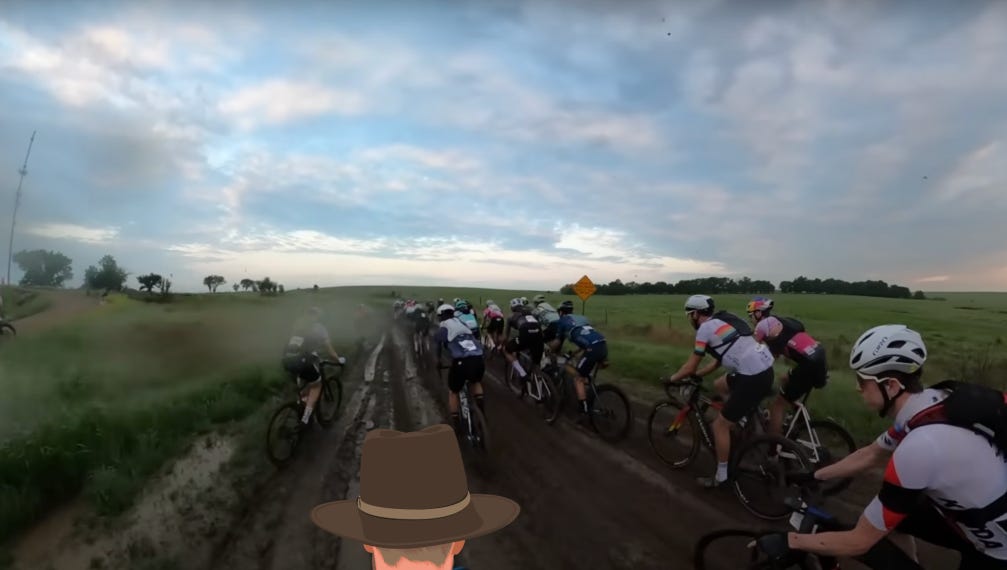
Despite the fact that gravel racing has become more formulaic, it began as adventure rides on seldom-ridden roads and still remains unavoidably chaotic and difficult in undignified, obnoxious ways. Let's take a moment of silence for everyone who suffered through Unbound 200 23' when thousands of people were ground down into walking their bikes through peanut butter mud for six kilometers in the first 15 miles.
[silence]
However, peanut butter mud isn't all a gravel racer will have to suffer through in gravel. The elements - rain, snow, punishing cold, punishing heat, humidity, etc - combined with loosely marked courses over cruel distances that often take detours through people's property and random abandoned ATV trails push even the most composed racer farther outside their limits than they'd hoped for.
Indeed, in gravel, suffering fetishists find their dream because, unlike other cycling disciplines - road cycling, cyclocross, mountain biking, etc- the distances (long af) and course choices (often technical and sketchy) increase the chances of suffering in a way that's not directly related to your legs hurting because you're pedaling hard. For example, road cyclist might race so violently it'll induce a non-weight-bearing hernia, but they're not riding so long that their butt cheeks chafe from pedaling so much.
So, indeed there is some space in this conversation to admit that, especially in gravel, being able to suffer in obscure ways is a requirement to realistically finish a gravel race, even if they don't do jack shit to improve your FTP. If you drop out just because your face is cramping, you're covered in cow shit, and you haven't eaten in 3 hours because of heat stroke, Unbound might not be for you, and you should consider going back to being a roadie.

Stories Tho
I'll get more into this in another article, but if you have a soul and legitimately like riding bikes, then a non-trivial part of you enjoys non-productive suffering. Remember - the bike wasn't invented for transportation; it was invented for torture, and on a bike, the human body's capacity for torture is bound by the imagination and the ability to suffer.
When you're blitzed at the club yelling at baddies while you're ordering extra bottles of Miller High Life, you're not telling the ladies (or the boys) about that time you perfectly knocked out intervals with magnificently portioned and timed carb consumption and stopped pedaling before the workout TSS approached harmful heights. Instead, you’ll tell them:
About that one time some idiot friend drove from Madison, Wisconsin, to Longmont, CO, while listening to adult novels to stay awake and avoid driving off the road, and then, even though he hadn't been riding his bike much, insisted on doing a 5-hour skull f**k ride up to P2P highway at 9,500 feet where we encountered torrential rain which of course he didn't have the body fat or clothing to handle which triggered a dormant hip issue because he was riding someone else's bike and ended up bailing on the ride by coasting miserably downhill for 80 minutes with almost no visibility shivering his ass off much like he had 12 years earlier in late November when he decided to ride up to P2P in summer bibs and somehow forgot that he'd have to descend for 40 minutes at 30 mph in 28F air.
Without suffering, we endurance dorks have even less worth saying, especially at parties.
Training suffering
Also, for the love of God, don't make me out to be someone who is claiming that suffering has no role in training and racing - you NEED to suffer in training, at least if you don't want to suck.
The essence of training involves strategically dosing effort for different durations to elicit advantageous race-specific adaptations. The language we use to describe effort - zones - is based on an athlete exercising to failure, which tells us functionally (not precisely) what effort roughly corresponds to what physiological state and what their ability is. And look, as you probably know, exercising to failure isn't pleasant - your body doesn't enjoy maximal exertion and lets you know by trying to get you to stop long before hydrogen ions interrupt your muscle contractions so much that your legs seize up.
Specific, non-negotiable training suffering doesn't end with maximal efforts, either. In the proper context, even recovery rides, which is why anyone who stays in the sport long is not only familiar with suffering but also codependent, which is understandable. Suffering is unavoidable if you want to pedal fast, so instead of trying to avoid it, it's easier to meet it head-on. If you get too enthusiastic about confronting suffering voluntarily, the overcorrection is that you start suffering just to suffer, which eventually makes you slow.
Conclusion: If you're trying, you're crying.
Good training requires suffering, but not too much suffering, which is precisely the sort of nuanced answer bereft of comforting binaries that you will cry trying to get right.
Slow, Mid, 38s is a reader-supported publication. To receive new posts and support my work, consider becoming a free or paid subscriber.