Against my better judgment, I have a YouTube Premium subscription and put zero limits on its incredibly transparent and manipulative algorithm, which serves me endless attention-draining slop that I nevertheless cannot resist, like a good Sweet Spot workout. One character that keeps popping up in my feed is some podcast called the ‘Road Man Podcast’, produced by some former middling semi-almost Irish pro whose real talent is producing the most click-baity headlines I’ve ever seen in my life. Here’s a sampling of some of his YouTube video titles:
1. 15 Years of Pro Riding - What Amateurs Don’t Know
2. New Study FINALLY Confirms what Cycling Coaches Have Been Saying for years
3. The Training Secret to Going FASTER after 40
4. How Pro Cyclists Get So Lean - What Amateurs Don’t Know
5. I Lost 9 kg Eating More (and Got faster on the Bike)
I’ll admit something, though — buried under these ridiculous headlines is one idea worth stealing. It quietly detonates fifteen years of conventional wisdom about how cyclists actually get lean, and it’s the only reason I’m writing this instead of ignoring him as I should.
Please subscribe. Glp-1s are super expensive, and if you don’t chip in, it’s a straight shot from here to the bottom of seven pints of Halo Top.
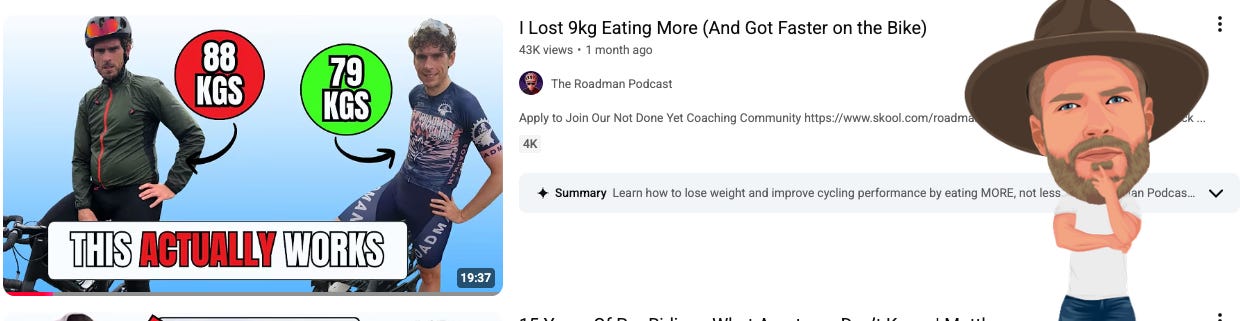
Sorry, but Eating More Food Doesn’t Make You Lose More Weight
I’m just going to go straight at the headline and call it what it is - a bald-faced lie, something straight out of Orwell’s Ministry of Truth, like saying war is peace, freedom is slavery, and ignorance is strength. If your takeaway after reading this headline is to go out and eat whatever you want, as much as you want, whenever you want, chances are you’re not going to shed 9kg in 12 weeks - you’re going to go the opposite direction.
The Laws of thermodynamics are not optional. Magical thinking doesn’t exempt you from physics just because you want it to.
But here’s what the clickbait headline buries: for fifteen years, endurance culture has treated fueling and body composition as natural enemies. Eat to ride fast, you stay chunky. Eat to stay lean, you ride like shit. Pick your poison, pick your identity, shut up and suffer.
What Road Man stumbled into — what Sam Impey and James Morton have actually been saying for a decade — is that this entire framing is broken. The same protocol that makes you faster is the one that leans you out. That’s the real story. “Eating more” isn’t the thesis; the thesis is that the false choice between fueling and body composition was a lie all along.
What He Did - The Counterintuitive Diet Protocol
Road man woke up one day and looked at the flabby, bloated reflection that came back at him from the mirror and decided enough was enough, time to go keto, time to listen to the advice of some of his own guests like Dr. Sam Impey and Professor James Morton (Team Sky personnel from the 2010s (not the TUE people tho)) and try something completely new - Fuel for the Work Required.
In practice, he :
Stopped eating the same meals daily. Previously on autopilot — same breakfast, lunch/dinner regardless of training. Now varies by day.
Actually fueled hard sessions (instead of under-eating to “create a deficit”). Pre-ride: ~2g carbs/kg bodyweight (~170g for him). On-bike: ~90g carbs/hour from mixed sources (gels, drink mix).
Trained his gut. Started wherever tolerance was (~40g/hr), built progressively to 90g/hr over ~8 weeks using glucose+fructose blends. Practiced in training, never debuted on race day.
Pulled carbs back (not total food) on easy/rest days. Still three meals, still adequate protein — just less starch/glycogen-loading when there was no glycogen to replenish.
Committed to 12 weeks, weighed weekly only. Weighed on Monday mornings, same conditions. Didn’t panic on flat/up weeks (week 4 went up). Trusted the framework.
Result? He lost 9 kg (that’s over 18lbs for those of us who think in imperial in 12 weeks, or roughly a pound and half a week, a wild, crazy rate of weight loss, especially considering he didn’t hate life, and his power was good.
I mean, if I were able to pull off something like this, I would be so psyched I’d probably break my own rules and write a clickbait headline that would put his to shame.
To really appreciate his counterintuitive approach, tho, I think we should go through six most important takeaways and look at the conventional wisdom vs. his approach.
Number One: The deficit is real; the subjective experience of “dieting” is what disappears
Conventional wisdom - to lose weight, you must feel restricted - smaller portions, skipped meals, willpower-driven hunger.
What actually happened - He ate less total energy per week. The big change was when the calories hit (a fancy name for this is periodization). Pre- and intra-workout feeds were huge (the ‘jaw sore from the chewing’ moments). In contrast, in easy days and post-ride windows, he ate less. The result? Overall for the week, he ate less, even if his peak meals around intensity and long days were up.
Read that again - the amount of food eaten during the week overall was lower, but on certain meals designed to support key sessions, he ate a lot more than usual.
This is what’s so counterintuitive in all this, and arguably worthy of the headline. The quiet part in all of this is that humans don’t quantify things like a machine weighing food on a scale - we encode things in memory subjectively, based upon phenomenology, or what an action feels like.
Conventionally, when people think of diets, they think of restriction, hunger pangs, and deprivations. Eating to match activity level, on the other hand, is the opposite of this - eating down 170 g of oatmeal, or over 1000 calories for breakfast before a hard/key workout is memorable bc it’s almost hard to actually choke it down - and yet, it works with the deficit math because it enables/supports a the hard ride which more or less burns it all off, and is not compensated for on days around it.
So, while the rules of the universe didn’t magically suspend themselves in his favor, the phenomenology of his approach is “I ate more than ever’, while the actual food scale would tell you “You ate less than last week overall”. Counterintuitively, both can be true; one is about moments, the other about totals.
Number Two: Under-Fueling A Hard Ride Makes You Eat More, Not Less
The conventional wisdom here is that if you want to lose weight, you'd better skip the pre-ride meal to create a bigger deficit.
Interestingly, Road Man fell into bad habits in week four and tried exactly that. The result? He blew up in the middle of the workout, limped home, and ate the house down, and the next day he was a couple of kgs up. Personally, I love this story because if you’ve been a cyclist long enough, this has DEFINITELY happened to you.
At some point, you’ve napkin mathed an improbably w/kg ratio you could achieve if you just weren’t so huggable and then put yourself into an energy deficit blitzkrieg and face planted at most a week later, right into whatever calorie-dense, hyperpalatable food you could get your hands on.
While you may have sworn to yourself never to crash-diet like that again, I doubt you fully appreciate just how damaging it is to your fitness. Under-fueling doesn’t just ruin one ride; it ruins the next 48 hours of your recovery and triggers a compensatory overeating pattern you can’t override without extreme will-power or pharmaceutical intervention, both of which, ultimately, aren’t sustainable. This is actually such a well-known phenomenon, it has a name - The Restriction Rebound - here are the steps:
1. Look at self, decide to lose weight.
2. Under eat before a ride.
3. Have a bad ride with shit power.
4. Binge after ride.
5. Gain weight.
Net result - fewer watts, more kgs.
You might think that’s bad, but recently, cyclists found an even better way to gain weight faster while putting out even fewer watts: fasting.

Number Three: Fasting is Reverse Doping
What’s the conventional wisdom here? Easy - our ancestors didn’t have a reliable food supply and had to fast for long periods, so we should also be able to go for 16+ hours without eating, and enjoy the same body composition they did, which modern life has robbed us of. In theory, it’s simple - ride without eating, use fat stores for fuel, and accelerate fat loss.
In practice, however, what ends up happening is you burn marginally more fat in that workout, put out terrible power (compared to your potential), come home on fumes, and spend the next 37 hours knee-deep in your refrigerator. The net result is that your weekly calories are higher than if you’d just eaten breakfast.
I want to pause us there and allow ourselves to absorb that terrible image I just planted in your head of what you do in a refrigerator after a fast, as well as three key words - ‘net result’ and ‘weekly’.
The core logic of this physics-defying ‘eat more to weigh less’ approach is about time scales. For example, it’s true that all of these classic diet interventions - eating less preride/during a ride or skipping eating altogether - produce superior deficits in the short term - let’s call it 24 hours - but the short term is not the time frame you really hope these interventions act on - you really hope they produce lasting, or at least semi-long term changes.
At its heart, the reason that these interventions don’t work in the long term is that their efficacy shares the same logic as the amount of watts you can hold on a bike - intensity is inverse to duration. If you go out and perform a sprint, or express the maximum intensity you’re capable of, it’s only going to last for about 10 seconds before your legs seize up and you have to slow down. The dieting equivalent of sprinting is something like underfueling or improperly fueling on rides, except, unlike sprinting, dieters are somehow surprised when their ability to sustain sprint intensity falls off, and instead of rightly attributing the failure to the approach, incorrectly decide they have terrible willpower.
You’re no more a failure for not being able to sustain those dieting interventions than you are for failing to hold your sprint power for three hours.
Number Four: Rest Days Are The Diagnostic, Not The Discipline Day
Conventional wisdom says rest days are where you “bank the deficit — you didn’t train, so you barely eat, white-knuckling it through the afternoon to earn tomorrow’s ride. The counter-argument you’ll hear from the adaptation crowd is the opposite: under-eating on rest days blunts recovery, so you should eat plenty regardless.
Both miss the point. If you fueled the hard days correctly — the 170g oatmeal bomb, the 90g/hr on the bike, the protein at dinner — the tell that you’ve nailed it is that rest days are quiet. You’re not ravenous. You’re not staring down the pantry at 9 pm negotiating with a sleeve of Oreos. You eat three normal meals, protein stays up, carbs drift down because there’s no glycogen to replenish, and none of it requires willpower because the system already paid you on Tuesday.
If rest day feels like a battle, you didn’t under-eat on the rest day. You under-fueled the ride before it. Rest days don’t need discipline when the rest of the week is built right. They just need attention.
Number Five: Chronic Carb Restriction on the bike = Anti-life
It might be hard to believe after the past three years in the cycling world, but 15 years ago, carbs were the enemy, and low-carb meant becoming lean and fast.
What we’ve learned since escaping Tim Noakes wet-dream is that when you deprive yourself of carbs, intervals turn to garbage, recovery collapses, you get sick more often, you skip rides, and worst of all - you start to hate riding because you feel awful.
I lived through those periods, and sometimes I wonder how many cyclists actually enjoyed riding during that era of trying to power every pedal stroke on ketones rather than carbs. I don’t have any hard data, but I would say that from about 2005-2017, the average cyclist pedaling around felt sad when they should have felt good because ‘the experts’ told them they were a failure unless they could ride at a race simulation workout for 6 hours on bacon and hard-boiled eggs.
Contrast that with headlines you see now like ‘Eating is cheating (eating more is like doping)' or 'Carbs are the enemy (of crap legs), ' and you can be forgiven for feeling a little whiplash from the incredible 180 the entire endurance nutrition industry has taken in less than 5 years.
The counterintuitive aspect of carbohydrates is this: when used properly (in terms of timing and amount), you will ride faster as a cyclist, feel better, and have better body composition than if you pretend an entire macronutrient group is the devil.
Number Six: I’m Not A Pro. This Doesn’t Apply to Me
Many people would argue that, unless you’re riding at pro volumes, matching food intake to demand doesn’t matter, and body composition issues are will-power issues.
While I’ll concede that not all things Pros do can be mapped to the amateurs, this dieting approach, besides actually lifting weights and never riding at Sweet Spot, is arguably the most copiable thing Pros do that amateurs could benefit from.
Amateurs have easier days in general than pros do, which means more natural low-carb days where the deficit builds passively. This dieting approach is actually more suited to a 10-hr/week rider than to a 30-hr/week pro.
The Takeaway of the Takeaway
The real counterintuitive thing in all of this isn’t “eat more, weigh less.” That’s just the Road Man headline — Ministry of Truth stuff. The counterintuitive thing is that fueling your training and leaning out aren’t in opposition. They never were. The protocol that produces the best watts is the same protocol that produces the best body composition, and the only reason we didn’t know that is that an entire generation of cyclists got handed the wrong question.
You don’t have to pick. You just have to time it right.
Share this with that friend who has a picture of Tim Noakes over their fireplace.
If You Want to Try This (and if you don’t, you’re NMGI)
Now, against all the cultural inertia of endurance sports, evidence seems to suggest a counterintuitive solution where people are literally having their cake and… running out of belt loops. While it’s anti-science to claim that current thinking will harden into an immutable fact, I really hope the efficacy of this ‘dieting’ approach proves true over time, because it's such a healthier, happier approach than the received wisdom handed down to so many riders.
If You Want to Give It a Shot
Open TrainingPeaks, flag each session as hard or easy.
For hard sessions, work two meals backward (dinner the night before +
breakfast/pre-ride meal) and load carbs there — ~2g/kg, eaten 90min–2hr out (3hr
for races.
Practice on-bike fueling: start at 40g/hr, build up. Mix sources.
Easy/rest days: pull back on carbs, keep protein and veg.
Give it ≥12 weeks. Weekly weigh-in. Don’t tinker mid-block.
The Mistake to Avoid
In Week 4, he tried to “hack” the system by under-fueling on a hard day (lowering carbs on both easy and hard days). Session blew up, overate after, weight went up. Half the framework and you don’t get half the results. You get the old results — bad rides, worse recovery, and the belt loops you started with.