Over fifteen years of coaching, athletes have left me for all sorts of reasons. Sometimes it’s financial (I have expensive tastes), personality incompatibility (if you don’t agree with everything I think, I despise you), or the athlete stops competing to raise a family or prioritize something else in their life (what a loser!).
But of all the reasons for an athlete to leave me, the one that always hurts the most is when they set up a video call (why call me up? If you’re going to break up with me this way just text) and tell me, with a straight face, that they’re done with structured training because it’s ‘unnatural’ or ‘inhuman’ and they’ll “just train by feel” instead. Then they pause to see if I’m going to try to convince them otherwise, but little do they know that while they were talking, I was already busy blocking their number and removing them from my Christmas list.
Why don’t I bother trying to win them back as an athlete? Because it’s a waste of time. If an athlete feels this way, this is a perfect time to channel your Mel Robbins and ‘Let them,’ because until the athlete spends a lot of time training by feel and slowly, and then suddenly (after months pass and the last vestiges of the performance bumps from structured training peter out) they end up barely training at all. This is an unteachable lesson, and nothing I say can replace learning the hard way.
Nevertheless, I love being right, so I’m going to tell you exactly why training by feel won’t work. So when you spend two to three years training by yourself and getting worse, you feel extra shitty when you come crawling back to me because your FTP has sunk to below recreational levels. Vibe Training doesn’t work because:
Your feelings are goddamn liars
Your feelings are not random
Proper training does not feel good
The definition of insanity is?
You’ll become inconsistent
Exceptions don’t disprove my point
You can’t fail
Your Feelings Are Goddamn Liars
First off, your feelings are not reliable sources of information in and of themselves — they’re just not. Thinking that is at best wishful thinking and at worst gross self-deception.
Do this: go through your day and honestly write down all the things you feel and want to do but deny yourself.
For example, did your boss piss you off during a meeting, and did you have to resist the urge to stab them in the eye with a pen? Did someone cut you off while driving home, and did you secretly wish to genocide their entire bloodline? Or, forget violence — how many times did you have to tell yourself not to eat this or don’t drink that or don’t stare at that hot person because you’re married, etc., etc., etc.?
If you don’t subscribe, I have to beg Vibe Trainers to take me back as their coach, or go back to working at TrainingPeaks. Please give me money, you know you like my writing and will miss it when it’s gone.
I bet if you wrote out everything you feel but don’t act on day to day, you’d use up quite a few pages of that Moleskine notebook you think your significant other doesn’t read.
And that thing you have to resist — this feeling that you don’t control and constantly say no to — this is the thing you’re going to base your training off of?
Your Feelings Are Not Random
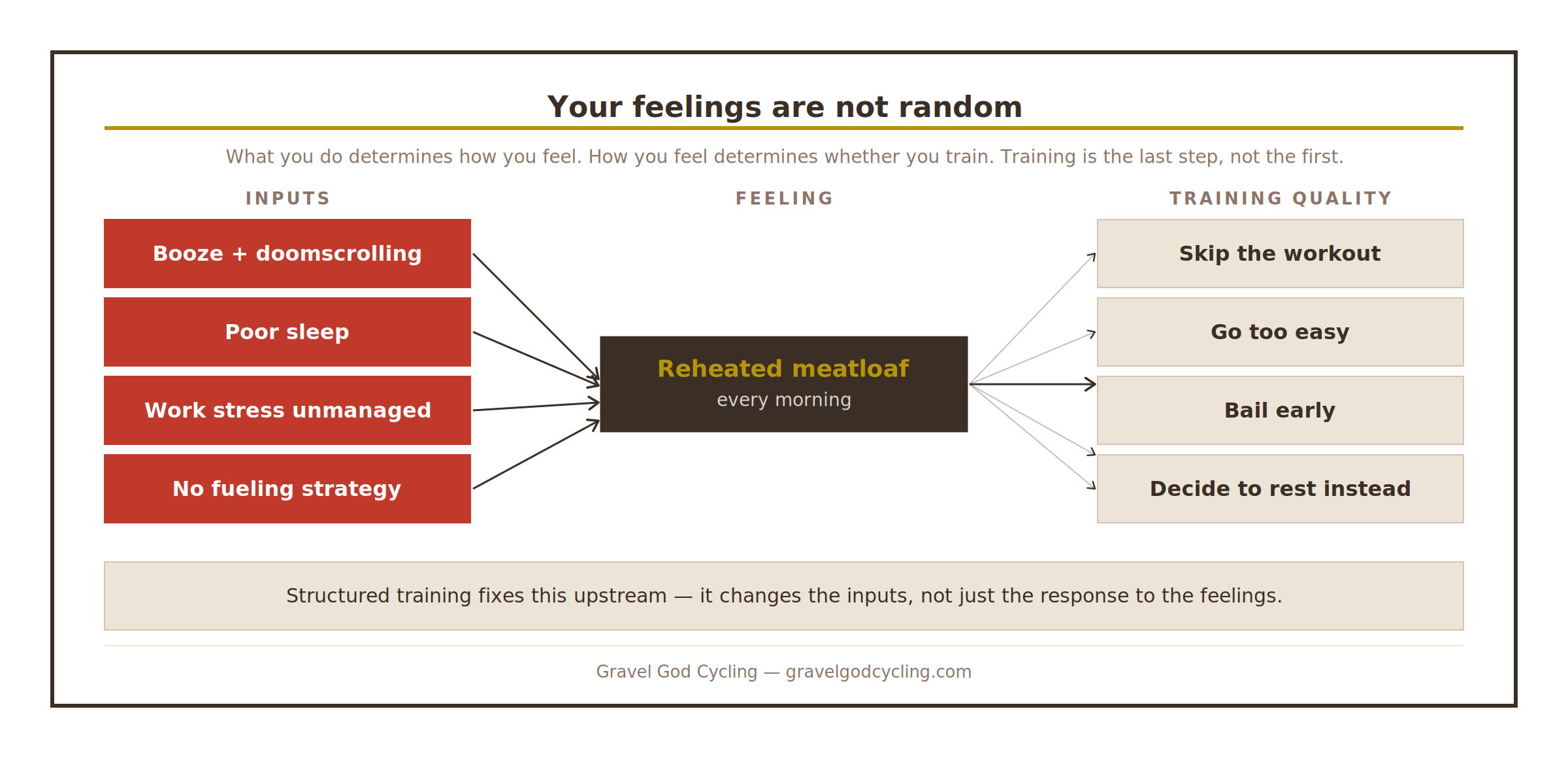
While this may come as a surprise to many, what you choose to do shapes how you feel. Like, if I decide to down an entire box of Fiber One for dinner, I should not be surprised if I spend most of my night hugging a toilet, praying to Jesus rather than sleeping. When I wake up the next morning, I might feel relief, but I won’t feel great.
Conversely, if I treat my body like a temple — fuel properly, sleep well, manage work stress, avoid the cliché substance and lifestyle pitfalls like drugs and alcohol, maintain healthy friendships and a solid, sex-filled intimate relationship — there’s a strong chance you’re going to feel freaking RIPPIN’ all the time, and that’s before we even get into training correctly with intensity control.
So when an athlete looks me in the eye and says, “I’m just going to ride based on how I feel,” I think to myself, “You mean you’re going to base whether you train or not on whether you can resist woofing down two or three margaritas the night before a workout?”
Again, your feelings do not arise out of nothingness, but for some reason I’ve seen lots and lots of athletes talk about how they feel on a day-to-day basis with the fervor and conviction of a televangelist fundraising for a new jet, and in every case I think to myself, “You think your feelings are some sort of accident?”
What you do, in large part, determines how you feel. I’ll grant that you can randomly contract ass cancer, or get horribly injured, or otherwise get mauled by fate — or your ex-wife in the car you paid for but she got in the divorce — but for every instance of one person getting absolutely rolled by fate, 99 other people are bemoaning how they feel when those feelings are just the lagging outcome of hundreds of shitty habits and decisions. Like doomscrolling before bed for six months straight after “winding down” with two or three glasses of whiskey, and waking up every morning feeling like reheated meatloaf.
And why does structured training stop this? Because it tells you ahead of time when you need to get your shit together so you actually train well. In the absence of that planning — of knowing what to do when — you never have a reason to change the behaviors that produce the downstream feelings you think you should base your training on.
Proper Training Does Not Feel Good
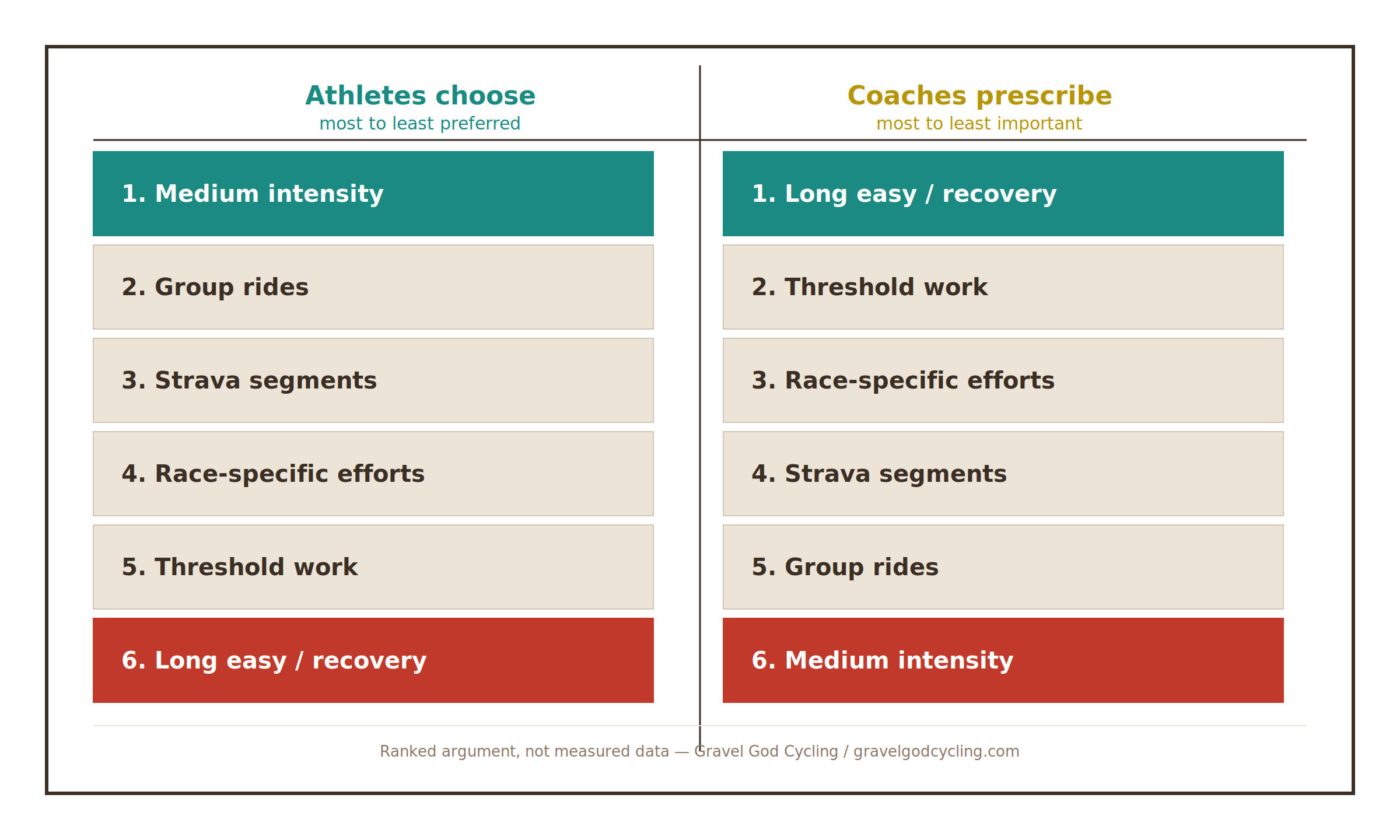
In my observation, whenever I give athletes free rein to do whatever intensity they want, they mysteriously choose intensities and durations that map perfectly to their strengths. Sprinters go hard for short durations. Climbers go hard for long durations. You know what I rarely see? Athletes, when left to their own devices, choose to go hard in the exact way they’re not good at — which is too bad, because if you could get reliably faster going hard in the exact way that felt the best, no coach would have a job and the entire field of exercise physiology would be pointless.
Instead, the best training is identical to the best torture — patiently, methodically performing specific, incredibly painful actions to produce maximum discomfort (or in training terms, the best adaptive stimulus).
This actually makes a hell of a lot of sense. Where else in life do you get something incredibly valuable — money, a significant other, a skill, respect — without paying a cost? Exactly. The degree to which something is valuable is proportional to the difficulty of getting it. This is one of those uncanny fractal patterns in life that holds across multiple domains and makes you really uneasy if you’re an atheist, because a truth operating across multiple levels feels so unlikely as to be impossible to manifest by chance.
I digress. The real point here is that the training that benefits people the most feels the worst to perform. No one stumbles into 3 sets of 10 repetitions at 40 seconds all-out, 20 seconds off. Anyone who has ever done 40/20s will tell you the same thing — the last 10 seconds feel like hell. If they don’t, you’re not doing it right, and that’s a feature, not a bug. The last 10 seconds are the point.
So when an athlete wastes my time on a video call telling me they’re just going to ride by feel, I think to myself, “Sure, you will. You’ll ride hard right up until the point where you’d have to hold the intensity that makes the changes you don’t want to pay the price for.”
What Is the Definition of Insanity?
Doing the same thing and expecting a different result.
So many Vibe Trainers initially come to me asking for coaching because they haven’t improved as much as they’d like or had the results they were looking for — and then, when the structure doesn’t immediately pay off, they decide the structured training they’ve barely tried was the issue all along, and if they just vibe-pedal more they’ll hit their goals.
In response, I have a simple question: if what you were doing was working, why haven’t you already achieved what you wanted?
That question is actually incredibly insulting, but I’ll stand behind it. I mean, really — if your feelings were a good basis for pedaling faster, why hasn’t it worked? Oh, it hasn’t? So why would continuing to train by feel magically produce a better outcome?
Your Desire to Train Isn’t Consistent
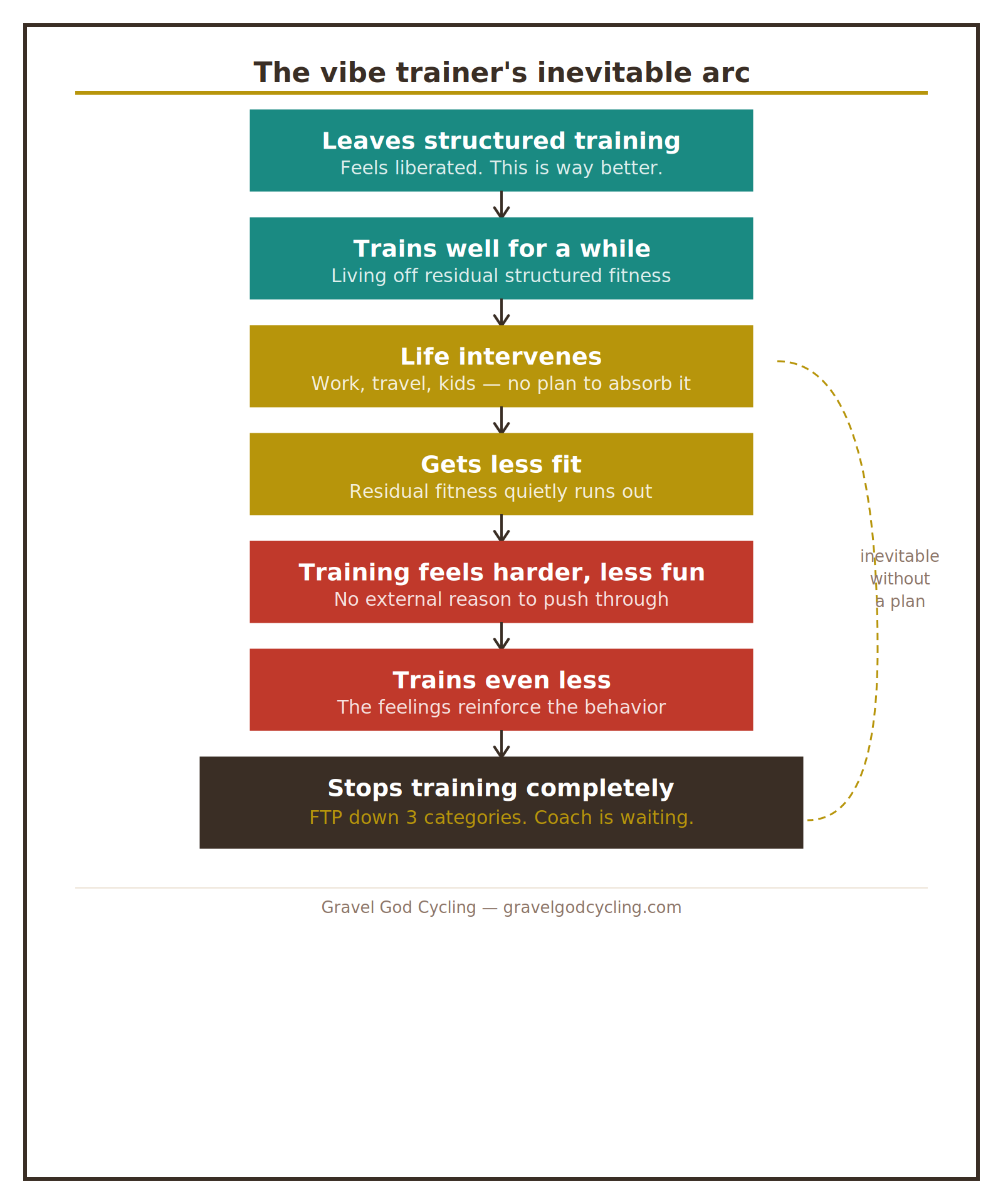
Every single person who has ever left me to vibe train and come back has had the same thing happen to them:
They trained well for a while.
Life came up.
They didn’t train as much.
They got less fit.
Training felt worse and wasn’t as rewarding, so they trained less.
They got less fit.
Eventually, they stopped training completely.
This happened to every one of these Vibe Trainers. And while I might sound judgmental, I think this pattern is totally understandable. Life does come up! Sometimes you do have to prioritize other things over pedaling really fast.
But what I take from all this is something that’s underappreciated about structured training: on a long enough timeline, maintaining high training quality based on your feelings invariably puts your fitness in one place — the gutter.
Why? Because what you do in life depends on your aim, and if the basis of your aim is your feelings, then your actions in the long term just become increasingly pathetic attempts at compensating for the consequences of indulging instant gratification.
You Can’t Fail
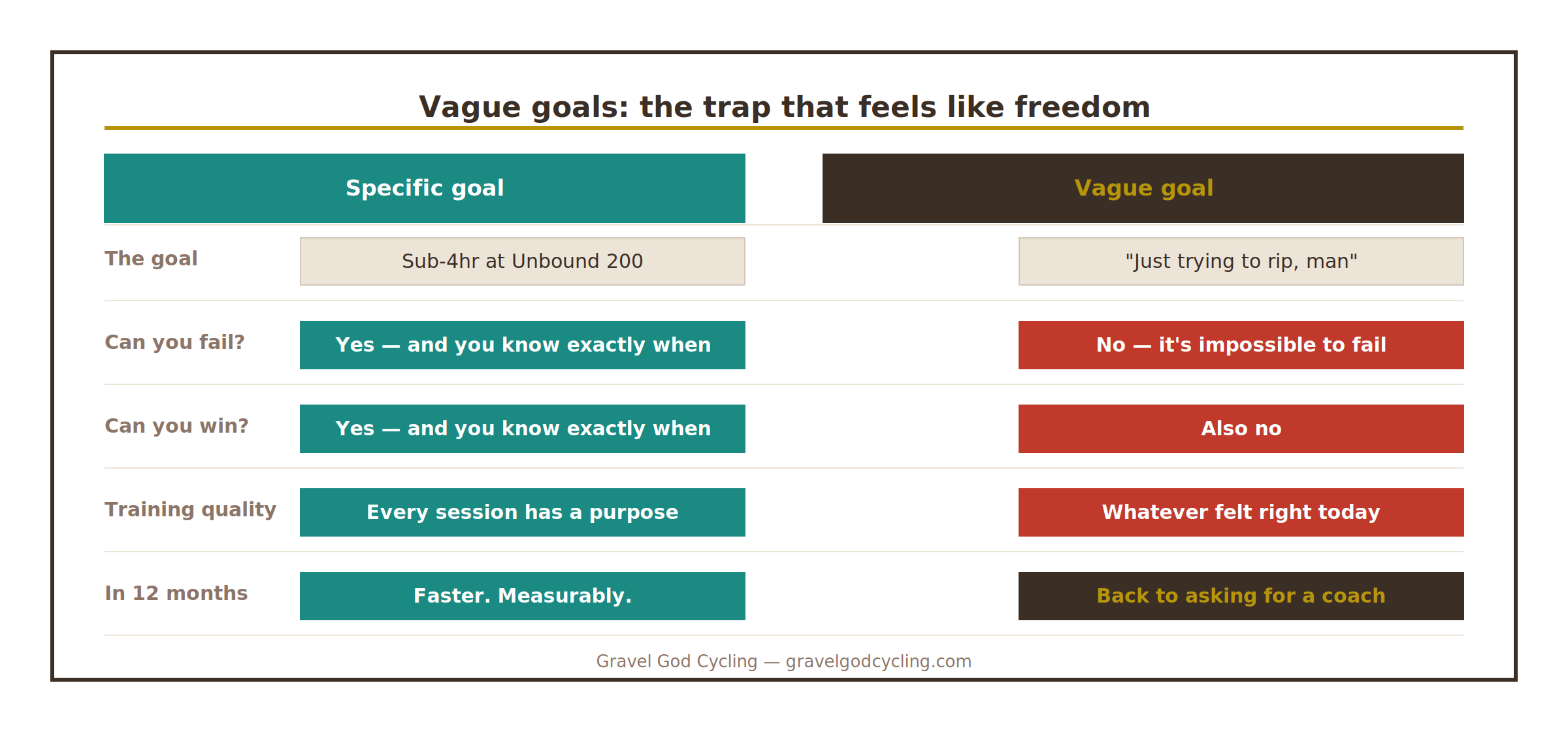
The ultimate reason athletes want to vibe train is that vibes, by definition, are hard to define. What’s interesting about people who train by feel is that their goals are equally as loose as their training methods. If you try to pin them down on some sort of goal framework, you quickly realize they’re evasive — and when cornered, say something like, “I’m just trying to rip, man.”
Why would you be vague about your goals? Easy — if you don’t have clearly defined goals, you can never fail, because you never committed to the conditions that would make success or failure black and white.
This might sound clever, but the tradeoff of never explicitly defining the conditions for failure means you simultaneously never specify the conditions for success. Sure, you can’t lose — but you can’t win, either.
And of course, in this age of irony, that’s a perfect stance, because no one wants to get caught actually trying. The most cringeworthy thing in the world is getting exposed as someone who’s pursuing something seriously, only to be seen as deficient if they fall short.
Please share this post with someone who needs to hear this.
Exceptions don’t disprove my point
Some of you have read everything up to this point with a smug look on your face because you know someone from the local group ride who’s the fastest, maybe even regionally fast, and they don’t own a power meter and have always trained on vibes, but no one can touch them. If I was that dimwitted I might share the same facial expression as well.
What you don’t see is that those people are not arguments against the worthlessness of vibe training, but simply another example of a concept most people never learn - survivorship bias.
Long story short, in WW2, airplane designers tried to improve airplane design and reinforced parts of planes that had bullet holes after returning from missions. While that seems logical, it’s actually dumb because it fails to take into account that all the planes that made it back from the mission did so despite the chassis. Other planes hit in places the planes weren’t hit didn’t make it back. The right course of action would be to reinforce sections without bullet holes on the planes that did make it back.
And so it is with your local group ride hero - they’re not the fastest because they vibe train, they’re the fastest because they had better parents than you. They could look at a bike and improve by 10%. They’re fast because God saw it fit, not because they spent the entire offseason in a bar and rode for a month and surpassed your best level.
The truth is, if they did structured training, they’d get even faster, but ironically, many don’t because they got so good without doing anything methodically that the second they have to grind for a second or do some hard training, they fold because they never had to develop a work ethic. Every town has these people, and everyone who sniffs their chamois thinks they’re God's gift to cycling until they see them compete against people their own size and end up getting rolled by washed-up late 30s never-haves beens from Colorado.
And Yet, None of This Matters
I’ve made great points and am absolutely, one hundred percent correct — however, that doesn’t change the fact that athletes are well within their rights to tell me to pound sand and ride hard whenever they want at whatever duration they want, just to spite me.
Like a teenager with nothing better to do than rebel against the very people who brought them into existence and gave them everything they’ve ever had, it’s a natural part of the athletic developmental arc to finally stop giving your coach money and tell them to pound sand. It’s just that most athletes do it at the wrong time.
What I haven’t admitted is that training by feel does work — once you’ve, from an athletic development perspective, failed in every conceivable way, become unconsciously competent in executing training and racing, and built an identity that’s perfectly aligned with peak performance.
The issue is, most athletes who aren’t that advanced look at someone who has been doing structured training for fifteen years performing at a high level without a coach and think, “They don’t need structured training, why should I?”
Because they’re an artist, and you haven’t figured out how to hold your paintbrush yet. Your lack of fundamentals isn’t a style — it’s incompetence.
So sure, go ahead and train by feel. I’ll be waiting for you in a few years when your w/kg drops by three categories.