To my surprise, many people reached out after I posted this chart in a panic that they were not training enough and were blown away by the recommendations for different performance levels. And when I say ‘to my surprise’, I mean I completely expected that reaction for two reasons:
1. People, even those who are good with numbers, minimize the nasty implications of that chart so they don’t feel bad about themselves.
2. When most athletes get beat badly, they attribute it to talent rather than training.
1. Training Time Matters
Look at the chart again, focusing on the weekly hours for simplicity. I know you can read, but let’s look closer at this: The suggested average weekly hours to finish a 6+ hour gravel race is 10 hours, compete in eighteen hours, and podium is twenty-five. Those categories cover many athletes, but I propose we add another category under ‘Finisher’, which I’ll call ‘Ayahuasca.’
Ayahuasca is the trendy, famous drug upper middle-class bored suburbanites and Silicon Valley tech workers and CEO types travel all the way to Brasil to break up their rudderless existence, which they mistakenly think is similar to drinking a case of Millers by themselves or huffing a bit of horse tranquilizer but is really not a recreational experience in the slightest and often results in what amounts to a psychic break and reneging on all prior life commitments in favor of pursuing some variety of Eat Pray Love life arc.
Thanks for reading Slow, Mid, 38s! This post is public so feel free to share it.
What those people don’t understand is that you can skip all that trouble and elicit a similar experience (minus the psychic break) by signing up for a long gravel race and not preparing for it - That’s why I call this category the ‘Ayahuasca’ category. Still with me? Cool.
So, do this. Imagine you’re at the start line of your first gravel race in mid-April. There’s a person to your left and a person to your right. The person to your left is in the Ayahuasca category. You’re in the ‘Finish’ Category. They’re in the ‘Competitive’ Category. If we take the averages, how much has everyone trained leading up to this race?

So, by the time you all roll up to the start line, the “Ayahuasca” rider has logged around 75 hours, you’ve trained 150 hours aiming to finish, and your competitive neighbor has clocked 270 hours.
Did you just black out? THINK ABOUT WHAT THAT MEANS!!!
That person to your left on the start line has trained half as much as you have! Do you think that increases your chances of beating them? If you extrapolate that out to a year, for every year they train, you are training two years! You are lapping them.
Oh, and that ‘Competitive’ person to your right? They’ve trained almost TWICE as much as you have! If you extrapolate that out to a year, for every year you train, they’re training two years! They are lapping you.
I feel like I’m forgetting something. Like maybe I haven’t mentioned an entire category in this conversation. Oh yes - the podium category! Below is a fuller picture, adding the Podium level into the mix. We’ll use the same assumption—training from January 1 to mid‐April (~15 weeks).

So, the “Podium” rider is logging 375 hours over those 15 weeks—5 times the Ayahuasca volume and 2.5 times the Finish volume. Compared to even the Competitive rider, it’s still more than 100 additional hours of training.
Quality-Hole
Maybe you’re a Quality-Hole, though. You may have a subscription to TrainerRoad and think that if every workout you do every week is some variety of Sweet Spot, there’s no quality in quantity.
Well, you’re wrong, but I’m in the mood to humor you. Let’s assign a quality factor that’s inversely correlated with total volume and assume something that’s not true - that people in the lowest training volume category - Ayahuasca - have a greater training quality factor than people in the highest training category - Podium. For each category, I’ll assign a Quality factor and then multiply that quality factor to determine what I call ‘Effective Hours,’ or how productively that time is spent. This is what you get:
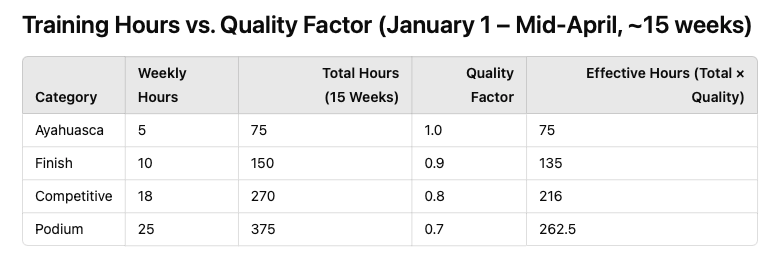
The result? Even if you assume Ayahuasca people have perfect training quality (they don’t) versus the shabby training quality of a Podium category person, at the start line, in effective training hours, they’ve still trained well over three times less than the Podium category athlete. Is the horse dead yet?
What I’m getting at is this - when you pull up to the start line in mid-April and survey your competition, realize that many people you’re staged next to are training double or even three times as much as you are! When you finish the race and see them showered, dressed, and already mowing down their second burger, your default assumption that their success comes from their mom and pop passing some Michael Jordan mitochondrion isn’t just wrong, but actively sabotaging you.
2.”They’re just a freak.” Keep telling yourself that.
What’s sabotaging you?
Attributing performance to talent (out of your control) that what is better explained by training (in your control).
I’ve heard many, many athletes talking through their results and then looking at names that aren’t even at the top of the list and saying, ‘Well, can’t feel bad about being beaten by Stevie/Suzie - they’re a genetic freak!”
Why do athletes do that? It’s a form of self-soothing, like a blanket or a pacifier—it’s cope, as the kids say. Honestly, it’s a great strategy, because, in addition to making the athletes feel better about themselves, it does two other things:
Gives them an excuse not to train more.
All but guarantees they never beat the genetic freaks because they’ve mentally pedastalized them.
In general, the only good thing anyone gets out of saying, ‘They’re just a freak’ is that the athlete ends up feeling good (here we are, back to fee fees again). Other than that, that statement robs them of agency (the ability to change their own life) and elevates their competitors, conveniently rendering them a performance victim. I can’t remember who said it (Richard Bach), but “if you argue for your limitations, and sure enough, they’re yours.”
And that’s fine - you can live by this principle and have a good enough life, you’re just not going to get as fast as you would if you trained more.
Case Study: Hayden Pucker aka ‘Farm Watts’
You don’t have to believe me, but here’s an example that sounds like lies but is unfortunately true.
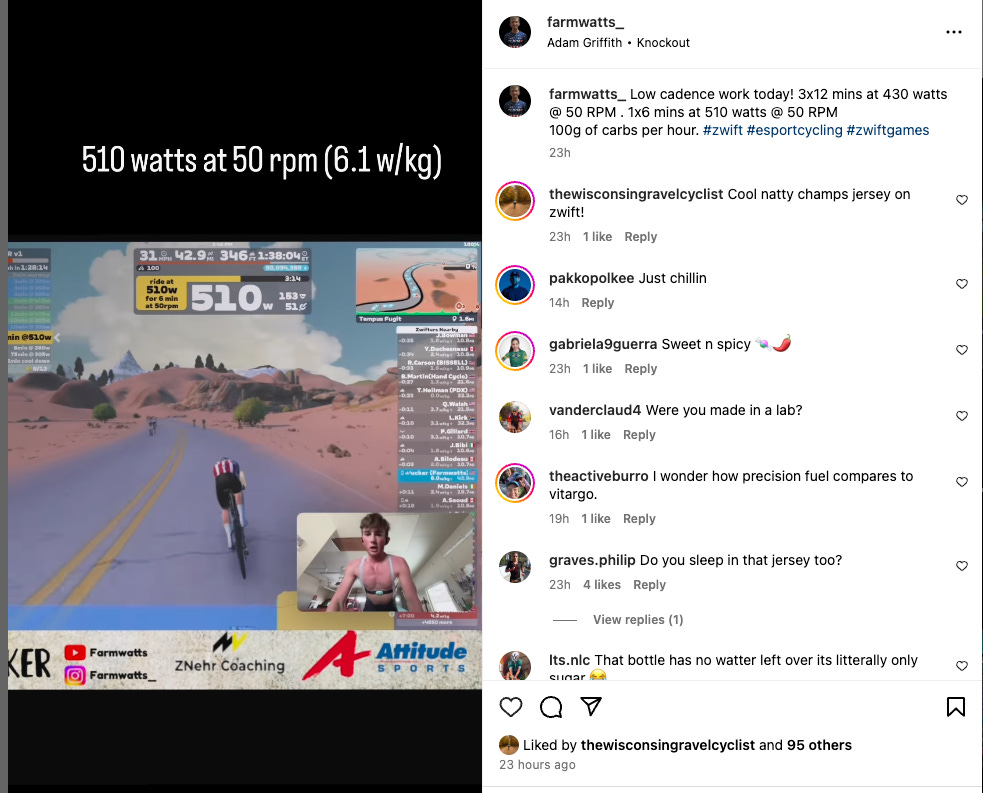
Hayden Pucker is a cycling mutant from a small town in Wisconsin. By day, he’s a Landscaper for his family’s farm, but at night/early morning, he’s destroying his smart trainer in his garage with watts normally associated with industrial snowblowers. Look what he puts his cranks through:

If you’re like me, you read this and thought, “That’s a typo,” or “Where is he getting his EPO” or ‘He’s a freak.” But it’s for real, for real!
And what sort of training was Hayden doing prior to being discovered? After getting turned off by the swimming part of the triathlon, he decided to just ride his bike. No plan, no intensity - just getting after it. How much did he ride his first year?
36,000 miles, or just over 100 miles a day.
That’s not bullshit. You can verify it here if you’re skeptical.
Again, if you’re like me, my first reaction was a mixture of disbelief and then quickly jealousy once I realized this was true. My ego wasn’t done, though; it went on the offensive, searching for special life circumstances that would make this volume less impressive. So I asked him directly:

To recap:
Pucker has a full-time landscaping job.
He works from 7 am to dark.
He gets up at 2 am so he can ride Podium level volume.
Conclusion?
Comparison really is the thief of joy.
I’m not sure about you, but I was much happier before I ever saw that training volume chart and knew Hayden Pucker existed.
Slow, Mid, 38s is a reader-supported publication. To receive new posts and support my work, consider becoming a free or paid subscriber.