
When I first became a parent one of the jokes people would insert into dead air as they witnessed us (mostly me) struggling to figure out basic tasks (uh, which way am I supposed to wipe the baby again?) was to lament the fact that baby's don't come with a user manual. It's not a great joke, to be fair, it beats just staring awkwardly at the hapless parent, deepening their embarrassment and doubling their resolve never to have children and keep basing their personality on exotic, hungover brunches.
Anyway, kids don't come with user manuals, nor does life, or so they say. Except, just like so much prevailing wisdom few think to challenge, I'm not so sure that life doesn't come with a set of instructions, or, if it doesn't, that you can't just make them with a simple Word doc, a notepad, and the most challenging part—consistently remembering to write shit down.
please subscribe I may or may not have knocked up my wife again on accident and need cash bad

Why Would You Do This? God, You're Weird.
So yeah, from a very young age, I've observed the world around me, had epiphanies, and written them down. Thematically, the content always centered on whatever I happened to be completely consumed with at the time. Dinosaurs, comic books, soccer, and then a long, tough, torturous turn to women when puberty arrived like an uninvited guest that refused to leave. And what's the result of all that glorified journaling?
Setting aside peace, the rarest thing in life - clarity.
Documenting my journey in various pursuits not only enriched the experience of whatever I was doing, but it also made me better at it, faster.
If you've been wondering what the point of this column has been so far, that last sentence was it—journaling makes you better at whatever you're doing faster.
You see, for better or worse (I'd argue better), most of us aren't wired to remember much for long. On it's face, this might sound like a terrible flaw of humanity, but when you consider the violent, capricious, nightmare world of our ancestors, frequently losing children, possessions, limbs, etc to mauradering neighbors, not to mention oversized carnivores and the random yet frequent plague or act of nature, you'd realize that it's a blessing, not a curse, that our memory is mostly worthless, especially when we're supposed to remember something good that happened to us (like suceeding at something) rather than bad (like when your spouse left you for a Life Time Grand Prix athlete).
So, while our (mostly) worthless memory is great for sustaining the will to live amid catastrophic sorrow and loss, it's garbage for remembering the things you should be doing to most efficiently get what you want - in our case, superior cycling performance.
You know how when you're riding you have great ideas but don't want to stop because you know if you do your coach (me, obviously) will see that you stopped during your endurance ride therefore invalidating the entire training stimulus and potentially jeapordizing not only your development but your future in the sport so you don't stop and then when you finish the ride you remember that you had an idea, but, maddeningly, that you can't remember what that idea was? Yeah - you should just stop and write the idea down in your notes.
Why?
Because those oxygen-fueled epiphanies are fleeting yet invaluable. The connections you make when you're riding or reflecting on some process are little murmurs from the Creator telling you what you need to do to kick ass.
If you collect enough of those, eventually, you'll find that you accumulate a body of work, a corpus, if you will, and suddenly when you wake up with a touch of hangover, or in a strange hotel somewhere, or just more confused then normal, you don't need to restart from zero and spend time grasphing for orientation in the world, you can open up your user manual, the culmination of years of insights, and remember exactly what you need to do for you.
How is this valuable, tho?
As I say, it stops you from wasting your most precious resource - time.
Part of the main functions of a coach (or at least a good coach, a coach worth investing in) has nothing to do with planning workouts, but remembering the idiosyncratic, stupid shit my athletes do that they keep forgetting not to do, which sabotages their progression, happiness, and even worth as human beings. I currently have openings; feel free to apply. Please apply. I had to disconnect the electricity last week.
The key word in the last paragraph is a word my friend who lives in Ouray would roll his eyes at, but I can't help but include it because I'm literate - idiosyncratic. These errors (or optimizations, also) are particular to that person; they're not necessarily obvious and definitely not generalizable to everyone. They're only discoverable after that individual acts, and usually only fully understood by the person in question - no matter how much I squint at a TrainingPeaks file I can't know, for example, that listening to 'Song 2' by the Blur was the reason you smashed that last interval (though I might if you had bothered to comment like I ask you to when you're my athlete).
As you might imagine, if you write down enough of these idiosyncrasies over time, you get much closer to the 'ideal' pattern of actions and Frame (mindsets, values, beliefs) you need to succeed. In other words, you figure out how to unlock yourself if you consistently journal about your journey.

But Don't Call it Journaling
Just… don't call it journaling. When I think of journaling, I think of a young tween agonizing over the silence from a young heartthrob to her increasingly unhinged DMs, not adults consistently writing brief little passages about their lives.
Solution? Rebrand. You're not journaling, you're creating a user manual. There - you're now a less embarrassing person.
Please share this blog so I’m not anonymous people who film themselves sleeping have more followers than me good God.
But Wait - What Should I Write About?
Oh, fair.
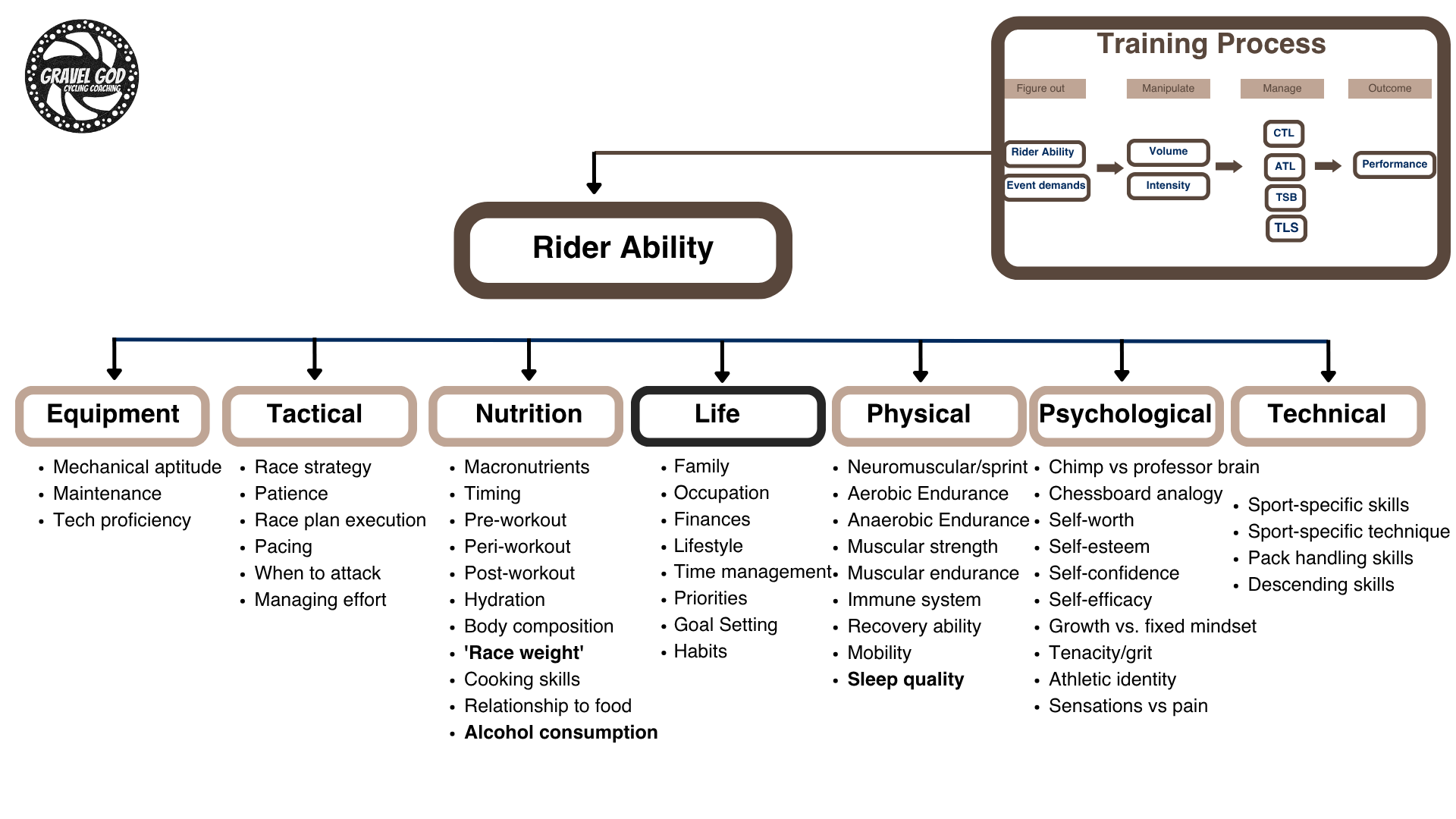
So, at no charge to you, I've included what I consider to be the most relevant categories to build your user manual out of to optimize yourself as a rider. Look at this nifty infographic above, which you can shamelessly download and look at because it's visually gorgeous and devilishly insightful.
You'll notice the following areas:
Equipment
Mechanical aptitude
Maintenance
Tech proficiency
Equipment transportation and setup
Backup plans and redundancy
Position optimization (aerodynamics, comfort, power transfer)
Technical
Sport-Specific Skills
Sport-specific technique
Pack handling skills
Descending skills
Cornering technique and line selection
Bike handling in various weather conditions (rain, wind, crosswinds)
Group ride etiquette and communication
Mechanical problem-solving during rides/races
Tactical
Race strategy
Patience
Race plan execution
Pacing
When to attack
Managing effort
Course reconnaissance
Pre-race routines and visualization
Post-race analysis and learning
Environmental/External Factors
Weather adaptation strategies
Altitude acclimatization
Travel and logistics for events
Course reconnaissance
Environmental condition assessment
Hazard recognition and avoidance
Emergency response skills
Weather assessment and decision-making
Route planning and navigation
Coaching Ability
Data interpretation (power, heart rate, etc.)
Video analysis skills
Performance tracking and trending
Goal adjustment based on data
Technology integration
Metrics selection and prioritization
Training program design
Periodization principles
Athlete assessment and evaluation
Communication of technical concepts
Motivation and feedback delivery
Injury prevention protocols
Nutrition
Macronutrients
Timing
Pre-workout
Peri-workout
Post-workout
Hydration
Body composition
Race weight
Cooking skills
Relationship to food
Alcohol consumption
Communication & Social
Team dynamics and communication
Coaching relationship management
Sponsor/supporter relationships
Media and public interaction skills
Mentoring newer riders
Conflict resolution
Leadership development
Life Management
Family
Occupation
Finances
Lifestyle
Time management
Priorities
Goal setting
Habits
Work-life-sport balance
Physical
Neuromuscular/sprint
Aerobic Endurance
Anaerobic Endurance
Muscular strength
Muscular endurance
Immune system
Recovery ability
Mobility
Sleep quality
Stress management techniques
Illness prevention and management
Periodic health screening
Age-related adaptations
Psychological
Chimp vs Professor brain
Chessboard analogy
Self-worth
Self-esteem
Self-confidence
Self-efficacy
Growth vs. fixed mindset
Tenacity/grit
Athletic identity
Sensations vs pain
Visualization and mental rehearsal
Competition anxiety management
Focus and concentration techniques
Competition Preparation
Pre-race routines and systems
Equipment backup plans
Logistics coordination
Warm-up protocols
Race-day nutrition timing
Post-competition recovery protocols
Competition calendar planning
That's a hell of a lot of information and definitely an opinion, a somewhat anecdotal representation of how I like to think about and build an athlete's user manual. Reasonable people can disagree on the categories, but I just won't respect you if you do.
How To Start Building Up Your Own User Manual?
Easy—download the blank User manual below and go through it, writing down everything you know—with some certainty—about what you would want someone to know about you if they needed to understand you in different rider ability categories.
A few tips here:
Keep it simple
Don't attempt to be too thorough
Don't do it all at once.
This is a living document. The real value in your user manual is that it's a resource you're refining, revisiting, and consistently remembering. You'll find that the more you work on it, the more it will work on you.
I'll also say that while this user manual focuses primarily on Rider Ability as a cyclist/athlete, obviously a user manual has arguably more utility when it touches on other, arguably more important areas of life like family, occupation, relationships, etc., all of which not only affects or influences your ability as a rider, but indeed, is subordinate to it and will directly benefit if you get your act together.

Sharpen your Pencil
As a parting note, I'll say that the digitization of everything obviously lends itself to building your user manual on your computer, but there's a strong case to be made that buying a few Moleskine notebooks, a packet of Ticonderogas, and a stimulant of choice is a better way to do this. Some evidence suggests that holding a pencil (or pen) lights up more neurons (and thus better insights) than tapping away at a computer.
I think the jury is out there, but I will say that few of us suffer from a lack of time spent staring at screens, and it's likely that sitting down over a fresh sheet of paper while you're forced to revive your atrophied, childish script is better for you than trying to funnel your thoughts through the computer and all its attendant attractions.
Plus, writing in a Moleskine journal is sexy. Aesthetics has a truth all its own.