
Credit where credit is due - you could not have made a more clickbait headline for me if you had offered me a free 2025 calendar filled with half-naked women covered in only Miller Lite tallboys:

And of course, once I clicked, I had to pay up immediately for the pleasure of working myself into a froth because the post was filled with sentence after sentence that relies more on persuasion techniques than evidence to support the article’s headline. I’m going to go through and rip this apart line by line and ignore any solid points or useful insights that might undercut my own. Ready? This is how he starts off:
Let’s be honest.
TSS is overused. Misunderstood. And often misleading.
I guess? I wish he’d tell us WHO oversuses it, misunderstand and is mislead by it. Coaches? Athletes? The general public? Influencers?
“TSS doesn’t tell you what you did. It tells you what a formula thinks you felt.”
Start using real numbers. Start using energy.
Strawman alert. The creators of TSS never said that the resultant number tells you want the athlete felt - it’s an approximation of the physiological cost of a workout, which is not the same thing as an athlete’s subjective feeling.
As for what constitutes a real number or not, I’m equally at a loss. 100 is 100 whether it’s 100 TSS or 100 kjs, the real question is the utility of the unit, TSS or kjs, in this case, is valid for …
Oh wait—we don’t know what we’re trying to measure or why yet. The author presupposes a reader has all the background knowledge to immediately make sense of this ‘debate’.
It was built to give structure. But structure doesn’t mean truth.
More straw here. TSS was not built to give structure; it was invented to give a better, if not complete, answer to the question ‘How hard was your workout?”
The next sentence, I have absolutely no idea what to do with - “But structure doesn’t mean truth.” Even if you incorrectly accepted the previous sentence as true, that TSS was built to give structure, I don’t see how you get to the statement that ‘structure doesn’t mean truth.’ As in the supposed ‘structure’ represented by TSS somehow doesn’t closely resemble a reality you’ve yet to define as important to who to do what?
As confusing as that last sentence was, it’s still less confusing than the arguments presented by Iñaki up to this point.
Why TSS Fails You
TSS means "Training Stress Score." It's a number. It estimates how “hard” a workout is based on your threshold. It was designed for cycling. It was a good idea 20 years ago.
I promised not to include quotes that make Inaki look good, but I have to admit that I was stoked to see him correctly define TSS instead of launching into another paragraph with another strawman.
Now? It creates more confusion than clarity.
Here's why:
Two workouts can have the same TSS but totally different recovery costs.
A 90 TSS run damages your body more than a 90 TSS ride.
A trail run with heat and fatigue messes up your heart rate. TSS doesn't care.
Swimming? TSS is just a guess.
Holy buckets, he’s making great points that are super valid, important criticisms of TSS!
The real problem I have with TSS is that it rewards intensity without asking if it makes sense. Your body doesn’t care about numbers, it cares about how much energy you used, and whether you used it efficiently or wasted it.
If you’ve been asleep so far, WAKE THE F UP, because Inaki just dropped his main argument, which are, in order:
TSS rewards Intensity without it asking if it makes sense.
Uh, I’m going to be generous and interpret his sentence as meaning that the formula for TSS weights (to the fourth power) time spent while exercising above threshold more than time spent below it, thus ‘rewarding’ the intensity more and potentially ‘inflating’ the number.
Your body doesn’t care about numbers, it cares about how much energy you used, and whether you used it efficiently or wasted it.
If you even smiled a little please consider subscribing I need money bad my kids are eating expired Wheat Chex for dinner.
Correct - the body doesn’t care about numbers - but it does care about energy flux, nutrient partitioning, stress, and homeostasis, and to the extent we can inaccurately but directionally quantify those underlying factors numerically isn’t an invalidation of using numbers.
The dependent clause here, ”…and whether you used it efficiently or wasted it,” I find stupefying. The body doesn’t ‘care’ if energy is used efficiently or ‘wasted.’ The body has been hard-wired over millions of years to obtain as much energy as possible for as little effort as possible, and if it expresses ‘caring’ in any way, it’s mostly to lie to you and tell you to keep on eating in the fear that a famine is just around the corner.
Use Work, Not Stress
I don’t build periodize based on time, distance, or TSS.
I use work. Measured in kilojoules (kJ). Because that’s what’s real.
kJ tells you exactly what your body did. No guessing. No assumptions. No made-up metrics.
Translation - instead of time, distance, or TSS, Iñaki uses work expressed in kilojoules to guide his training because it’s real, because time and distance are made up constructs, unlike the amount of energy required to apply a force of one Newton through a distance of one meter. Sorry, that sounded petty.
The big claim here is that the kjs expended during training tell you exactly what your body did. Except, it doesn’t.
Assuming we’re measuring kjs correctly (which most people in most sports can’t), citing the raw kilojoules expended only gives you a one dimensional view of the training - just like hours, or distance - that collapses the real goal of any metric that attempts to quantify training load - what was the physiological cost of the workout?
For example, you can expend 1000 kJ in 2 hours, or you can expend 1000 kjs in 1 hour, but the physiological cost of the former versus the latter is wildly different. The nutrient partitioning (the way energy is derived) required to produce 500 kjs every hour (moderate glycogen) is going to look a lot different than producing 1000 kJ every hour (A LOT of glycogen)
But I’m getting ahead of myself here - Iñaki proactively addresses my little parenthetical here about the problem of measuring kilojoules.
Now, I know what you’re already thinking:
“But running power meters aren’t precise.”
“How do you measure energy in swimming?”
“Cycling efficiency varies from one athlete to another.”
Yes. All of that is true.
But at least now we’re talking about a real metric. A measure of actual work. Of energy spent. Not a score someone invented to make data look clean. Not TSS, which throws all types of training into the same black box and pretends it’s the same.
Lololololololololol that DOES NOT remotely address a fundamental issue. This is Obi Wan Kenobi waving his fingers at the storm troopers - Nothing to see here.
You can call kjs ‘real’ all you want, but you just conceded that measuring energy expenditure is imprecise and that any number ‘measured’ outside the lab is just an estimation, so how ‘real’ is this number exactly? Even if we consider the unit (Kjs) to be more valid than other units (TSS, or hours, or miles, or kilometers), how ‘real’ is it when we’re just ballparking the number and have no idea how the energy in question was derived?
This is the right place to start.
From here, we can build. We can iterate. We can adjust how we track training load, how we align fueling with energy use, how we manage recovery. This is how real training systems are built: by looking at truth, not at noise.
Lol ‘real’ training systems are built just fine on noise all the time. You don’t need a perfect model of reality to navigate it. If your theory, even for the wrong reasons, consistently elicits physiological adaptations that improve performance, it doesn’t matter how you got there.
I’m going to skip a little bit ahead here and get to Inaki’s solution:
Don’t just train hard. Train inside what your body can recover from.
Use this:
Training Load = Weekly kJ × Intensity Distribution × Recovery Score
Where:
Weekly kJ = Total external load
Intensity = How much time in each zone
Recovery Score = Sleep, HRV, energy, stress
If your energy output is going up, your intensity is mostly in Zone 1, and your recovery is solid: you’re on the right track.
If one of those breaks down, you’re heading toward burnout. I’ve seen it too many times.
You'll be surprised to find that this solution - this way of measuring training load I find beautiful and probably much better than TSS. There, I said something nice.
The problem with this is every one of those variables he relies on to calculate training load have caveats that undercut his claim. Let’s briefly examine each variables weaknesses:
Weekly kjs - To calculate weekly kilojoules you need to calculate kilojoules expenditure from training activities which, we’ve already established (and he admitted) isn’t accurate.
Intensity Distribution - Calculating Intensity distribution is a minefield because that relies on how -what testing methodology and protocol- an athlete/coach determines thresholds and zones and in a best case scenario is still an approximation of their ability which makes their training intensity distribution on any given day another approximation at best.
Recovery Score - Calculating a recovery score will also necessarily rely on lots of sketchy measurements (are you measuring your HRV from a heart rate strap after waking up or from WHOOP?) and assumptions (How is the athlete reporting/quantifying stress?) that, again, provide an estimation at best.
So, if we rewrote the equation above, it would be something like Approximation x Approximation X Approximation = Superior training load metric. This may not surprise you, but I don’t find that method of training load calculation to be convincingly superior to using TSS.
Notice I said ‘convincingly superior’ there. I’m not making the claim that Iñaki’s training load calculation approach isn’t better, I just don’t think, both from a conceptual and ease of calculation standpoint that it’s as good as he’s making it out to be, and he makes that point for me when he says, “If your energy output is going up, your intensity is mostly in Zone 1, and your recovery is solid: you’re on the right track.” As you’ll see, the key clause here is “if your intensity is mostly in Zone 1.”
Arguably the end goal of all endurance training is to produce more output (speed or watts) with the less (or even the same) input (oxygen). Measuring training load in kilojoules will tell you if you’re on the right track IF, and only if you’re contextualizing kjs expenditure with the intensity at which it was burned, specifically if it’s being burned in a more or less completely aerobic (meaning with oxygen).
But you don’t need to calculate training load in kilojoules to see that, all an athlete needs to do is repeat the same steady state Z1 workout and record power or pace and see what their EF is.
In other words, kilojoules expenditure is only a meaningful training load metric until you add intensity to it which is the just answering the training load quantification problem that TSS tries to address from another angle without a clear advantage. So yeah, kilojoules are for losers, man (lol).
But anyway, even if you think my arguments so far are completely off base, I have a surprise for you - this entire TSS/Kilojoule training load argument is pointless, as you’ll see.
You’re Not Going To Believe This, But The Whole Argument Is Pointless Anyway
Here’s something that’ll win me a lot of friends - the smarter a coach is, the nerdier they are, the more they understand the net ATP products of biochem, the worse they are as a coach.
Why?
Because they’re too smart to understand their target audience. What 130+ IQ types always get wrong is that they walk around surprised that everyone doesn’t instantly recall everything from Algebra 2 in high school, that concepts and abstractions don’t appear clearly and easily, and why people act in such irrational, self-defeating ways when the right course of action is obvious (to them).
Hey idiot - that’s because you’re so f***ing smart that you’re dumb.
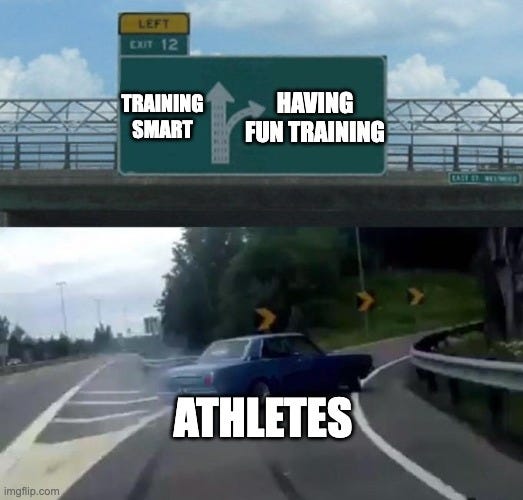
The real reason that measuring training load in kilojoules isn’t better than TSS isn’t because that’s not true on the merits, it’s because the reason athlete’s don’t train badly isn’t because the way they model training load is wrong, it’s because bad training is fun and smart training is boring.
That’s right - training like a moron is just funner (lol) than training intelligently. Consider:
What does bad fun training look like?
Going hard constantly.
Trying to drop everyone, even parapalegic and geriatric tandem riders to satisfy the ego.
Doing epic rides that well past your body’s ability to absorb or adapt to simply because your weekend is incomplete if someone’s ride on Strava was more epic than yours.
Underfueling on the bike to get painfully skinny even if it kills your power and recovery because looking fast is more important than being fast.
Mostly replenshing the enormous deficit generated from undereating by drinking booze and eating apps at trendy locations while pretending it’s a mystery why you look like a condom pulled over a skeleton.
Regularly bombing races and complaining to anyone who will listen on how much training you’ve been doing lately and it’s all part of your ‘plan'.
What does good boring training look like?
Carefully controlling training intensity.
Rarely trying to drop anyone outside a race, and even then only doing so when it makes the most tactical sense, never to make a statement for the ego.
Doing the least amount of training for the maximum adaptation, which results in most Strava ride posts as boring.
Fueling correctly before, during, and after training to maximize execution and adaptation.
Not engaging in the Licensing Effect whereby someone gives themselves mental permission to drink, overeat, and generally treat their body like a trash panda just bc they rode for awhile.
Understand that racing is not an FTP test, but it’s own skillset and regularly gets in the arena to sharpen tactical, logistical, nutritional, psychological acumen which they’ll need just as much as they do a big engine when the gun goes off.


The Real Issue
Inaki explicitly mentions who the inspiration for measuring training load by kilojoules is in his post - Alan Couzens - a somewhat famous triathlon coach that’s been ahead of the mainstream training consensus for years because he’s methodical, able to code (which allows him to use data from athletes he’s worked with to explore questions most coaches can’t begin to answer but simply blindly parrot other’s perspectives), and opinionated, to put it mildly.
Or, as Inaki put it:
And if there’s one person who’s been doing this long before it was trendy, it’s Alan Couzens. I’ve seen it. Years ago, before the endurance world knew who he was, I called himThe MAD Scientist, not because he was crazy, but because his ideas were too far ahead for most people to accept.
Later, we became a small group, what he called The MAD Crew. Elite athletes, age groupers, and a few coaches who trusted his “crazy” thinking. Now we all gathered in a private forum to share data, progress, and ideas that felt years ahead of the mainstream: MAD Crew Forum
And what’s the problem with Alan’s science?
Nothing - he’s brilliant, honestly. I mean, the guy wrote a goddamn textbook called the Science of Maximal Athletic Development which should be required reading for anyone that’s even looked at a bike.
In it, he convincingly demonstrates what it takes to fully develop as an endurance athlete and builds his case by demonstrating that most of modern life undermines that pursuit and therefore a key pillar of becoming as fast as you could be on a bike (or running, or swimming) requires changing your life priorities, commitments, and circumstances to facilitate maximum athletic development, which is true and also exactly where he loses most people.
Why?
People don’t want to maximally develop athletically; they want to maximize fun.
Athletes don’t ignore his ideas, or debate whether to measure their training load by hours, or TSS, or kilojoules any more than they consider quitting their day job and not having kids so they can move to Flagstaff, AZ and refocus the next twenty years of their life on putting out a few more watts per heart beat. Those conversations are completely pointless until you can convince someone to care more about their long term performance rather than their short term fun.
Metrics don’t need to change, what an athlete is trying to get out of it does.
Share this but please don’t share this with the wrong people and get me canceled and make me activate my only fans.