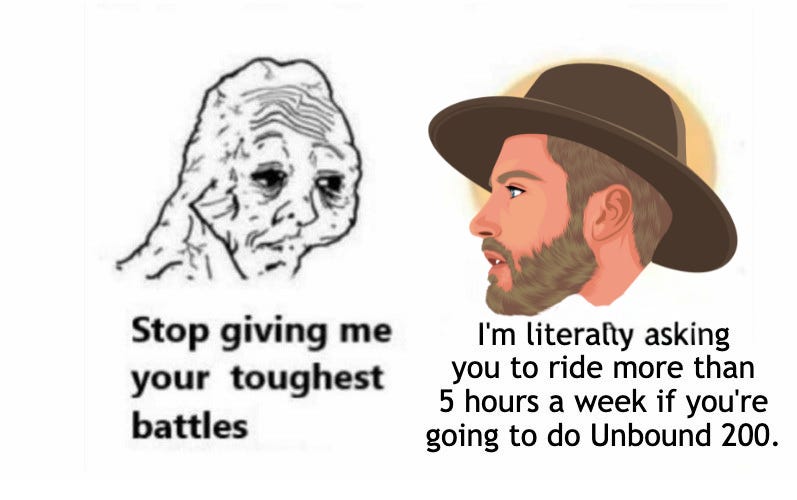
In the past decade or so, coaches have been told that the most important data they need isn't from an app or device but from an athlete. Supposedly, they're supposed to ask how an athlete feels and adjust based on their answer! We'll charitably name this training philosophy Fee Fee Led Coaching.
This training philosophy contrasts sharply with 'old school' training, which fetishized pain and suffering (among other things) and cracked, injured, and ruined many otherwise talented, promising riders. Old school methods were short on results obtained from double-blind, randomized trials and long on anecdotal training methods passed down from previous generations of crusty, superstitious riders.
Since the invention of the power meter, old-school training methods have quickly been replaced by surgical, data-informed coaching strategies that quickly became paralyzing, buried underneath mounds of data no one knew what to do with. Ironically, the solution was to rely on an old-fashioned metric—subjective feeling—this time interpreted through the lens of therapy culture. The 'fee-fees' (feelings = fee-fees) movement has revolutionized endurance culture in the last fifteen years. It's also dead wrong.
Your training dgaf about yer life
While listening to fee-fees is important and good in my ways, it's pendulumed training way too far in the other direction from old school training and forgotten something fundamental:
If you want to be fast, your life needs to make space for your training; your training should not make space for your life.
Look, I know that statement is technically wrong, but there's a metaphorical truth that supports my biases.

First, we know what it takes to be good - we just do. Here's an entirely uncited yet incredibly accurate chart of the general training volumes required to not suck at gravel cycling.
Now, don't go and be an exception-hole to me. This chart may not be perfect, but it's pretty goddamn dead on for ballparking what it takes. Are there people who perform better on less training than this chart describes? Sure. Are you one of those people? If you have to ask, you're not.
While I'm loath to constantly appeal to the same analogies to support my ideas, cycling really is a blue-collar sport with a blue-collar work ethic where there's an inescapable amount of clocking in and clocking out required to 'make ends meet' (i.e., not suck).
Thanks for reading Slow, Mid, 38s! This post is public so feel free to share it.
If this annoys you, realize that I'm with you - I empathize- but doing a specific training volume is a non-negotiable reality of endurance performance. To continue with the work analogy, racing bikes isn't a sport where you can 'work smarter, not harder' and enjoy the same benefits of riding 20+ hours a week as you would riding five*. Realize that if this was the case, the best bike racers would have done it already but haven't, which proves that when people say 'training smarter = training less,' they're pedaling a bankrupt theory.
For those in the audience who don't race bikes at all, here's a universal truth I believe in that makes this article relatable—you can't 'work smarter' until you've 'worked harder.' This means that until you've worked many, many hours, it's not possible for you to work smart.
But I'll go further here. Part of 'working smart' is 'working hard,' if 'working hard' means 'working a lot.'
Which ideas have exerted some of the most toxic effects on society in the past ten to twenty years? You could argue that it's the '4-hour work week' by Tim Ferriss, the Time Crunched Cyclist and the Sweet Spot training zone inventor. All of them promised that you could get more doing less, which, while having some truth to it, I would argue is directionally wrong.
The truth is that most people just have to put in the time. It's all very formulaic, known, ill-suited to social media, and boring, but there's no escaping at some baseline level. You must work a certain number of hours and pedal enough pedal strokes if you ever hope to be good.
If we accept that there's no getting around punching the clock, we know how long the shifts need to be (see the chart) to save the money required to buy a few more GravelGod crypto coins (i.e. ride bikes fast) and perform those shifts makes you tired, the answer isn't to get pissed off at how much the GravelGod crypto coin costs or what the chart says, it's to figure out what it takes to do what the chart says so you're not tired.
Does that sound strange? It wouldn't work for you if you thought of other things that ask you to raise yourself to a standard, indifferent to all the snowflake reasons that 'wouldn't work for you.' Only in the cycling world is your training supposed to bend over backward to accommodate your fee fees.

When you applied to college, did you tell admissions, "I only felt like doing 1/2 the homework and never took the SAT. Where do I send in tuition money again?" No, not unless you wanted to go to a state school. You tried to get into a prestigious college to meet prestigious people and get a prestigious job so you could buy a prestigious house, fill it with prestigious stuff, and spend your free time doing something prestigious like racing bikes.
And how did you make sure that happened? You studied your ass off and volunteered at the soup kitchen and ran for student council, and studied for the SAT. YOU changed to meet a standard; you didn't bitch about the standard because the prestige inherent in high performance was worth ignoring your fee fees.
Yes, somehow, when it comes to training, fees are suddenly a defining variable because it's 'just a hobby' or 'I just do it for fun.' LOL, sure it is. Go tell your spouse that you're spending 15-20k this year spending time away from them and them for something you don't even really care about.
The Real Problem with Fee Fees
Maybe I've moved you a few times, but you're still not convinced that letting feelings dictate training, work, or anything you do is an issue. What's the big deal?
The big deal is that your feelings lie to you. If you let them dictate your life, eventually, you will do nothing. Nothing!
I'm not kidding - the internal logic of letting feelings drive your training, hell, drive your life, is that you end up arguing yourself into inaction because you, 'Didn't feel X today" or 'the vibes were off."
This is not a new insight. Our boy C.S. Lewis nailed this shit when he said:
The only people who achieve much are those who want something so badly that they seek it while the conditions are still unfavorable. Favorable conditions never come.
Neat, but how do I stop being tired?
That's another article. But for the time being, ask better questions.
Bullshitters ask, 'How do I stop being tired.' The real ones? "I've tried x, y, z, and I'm still really tired when I train. Any ideas?"
Slow, Mid, 38s is a reader-supported publication. To receive new posts and support my work, consider becoming a free or paid subscriber.
*Unless you dope.