K, now that we’ve covered a few budget-crushing supplements you can take that may or may not actually work but might replace training hard if you believe hard enough, let’s talk about supplements that actually work.
Before any of you start yelling, I realize that what I’m about to cover isn’t typically thought of as a ‘supplement'’’ since most definitions would say a supplement is something that completes or enhances something else, not something that doesn’t need enhancement.
Slow, Mid, 38s is a reader-supported publication. To receive new posts and support my work, consider becoming a free or paid subscriber.
CarbohydratesIf you had to dig the graves of all the endurance athletes who have never lived up to their potential because of their relationship to carbohydrates, you’d start to understand the rationale behind mass graves.
Remember above when I said a supplement is something that ‘completes something else’. Well, I lied - carbohydrates really ARE a supplement because unless you properly fuel during your training window, your training isn’t complete.
For example, let’s say after every hour of training you completed, you drank a beer—nothing too fancy, just a fine 4.2% Pilsner from a humble mill town on the Southeast corner of Wisconsin.
Sounds a little nuts, right? Why would you drink a beer after training for only an hour? Wouldn’t that sorta negate at least part of the hour of training? Well, yeah - no shit!
However, in defense of people who might consider drinking a Miller Lite after every hour of training, drinking one Miller wouldn’t be the end of the world. It wouldn’t be ideal training, but it wouldn’t completely cancel out the training, either.
And this is exactly my point—you can train without properly fueling with carbohydrates during your training window, just like you can drink a beer after training for an hour. In both cases, your training still counts; it’s just not as effective as it could be.
Just so we’re clear - I didn’t choose the drinking a beer analogy because I’ve got a serious problem with the world’s finest pilsner - it’s because if you saw someone drinking a beer after training for an hour, you’d think there was something really wrong with them, and they should change their habit. That’s EXACTLY what I think when I hear athletes tell me how they’ve fumbled their training window fueling.
Thanks, God
Our hunger mechanism didn’t evolve to perfectly represent our glycogen state during prolonged, medium-intensity, steady-state cardiovascular exercise.
For example, why do cycling noobs bonk? Because they don’t feel like they’re going to bonk. That’s right - FEEL! You may have forgotten, but non-endurance athletes primarily rely on their feelings to tell them if they need to eat something. The reason feeling isn’t a reliable way to optimally fuel, execute, and adapt to endurance training is that the hunger signals lag behind exercise demands - if you’re riding and you feel hungry, it’s already too late.
Notice the words I said above - reliable and optimal. You can definitely get away with relying on your feelings for many workouts - most workouts aren’t long and intense, after all. For many workouts, your hunger sensations might line up just fine.
The real problem is that even messing up nutrition because of a mismatch in hunger to need only becomes significant over time because fitness is the lagging, compounding outcome of your training quality. When training isn’t supported fully by nutrition, training quality drops, and eventually, you’re not what you could have been.

Culture
You might be too young to know this, but eating during training was looked down upon. I’m not kidding—eating was cheating!
Do this: Roll up to the local group ride, get next to the old crusty dude not wearing a helmet with disgusting, veiny (triumphant, lol) blood pipes for legs, and ask him what he ate during his long rides in 1995. Do you know what he’ll say?
“Nothing……PUSSY!”
No shit this is the kind of attitude that prevailed back in the day. It was a badge of honor to ride endlessly on the ‘bread and water’ diet, with emphasis on the water.
Was it effective? It depends on what you mean by effective. Sure, lots of people got super skinny doing that because if you don’t take in a lot of energy and expend a lot of energy, your body has little choice but to borrow energy from your fat cells, depriving many otherwise charming young cyclists that youthful, ‘baby’ faced look (and also of happiness).
Of course, being thin in cycling is worshipped overtly or covertly like a God because it does confer a performance advantage to a point, but emaciation doesn’t lend itself to power generation unless you sidestep low energy availability by increasing your blood’s oxygen-carrying capacity via artificial means. While it does seem implausible that current performances could match those of the past, given what we know about doping, there is a small part of me that thinks there’s some credence to today’s performances being clean(er) simply because people are eating carbs now instead of starving themselves and blood doping to make up the difference. Still seems like a stretch though. I digress.
Anyway, we’re not living through a communist revolution where ‘we are not burdened by what has been’ - past cycling culture still dogs current cycling culture. Things might be different, the vibes might be changing, but the old dysmorphias remain like the buildings outside Chornobyl - unoccupied but still visible.
Science
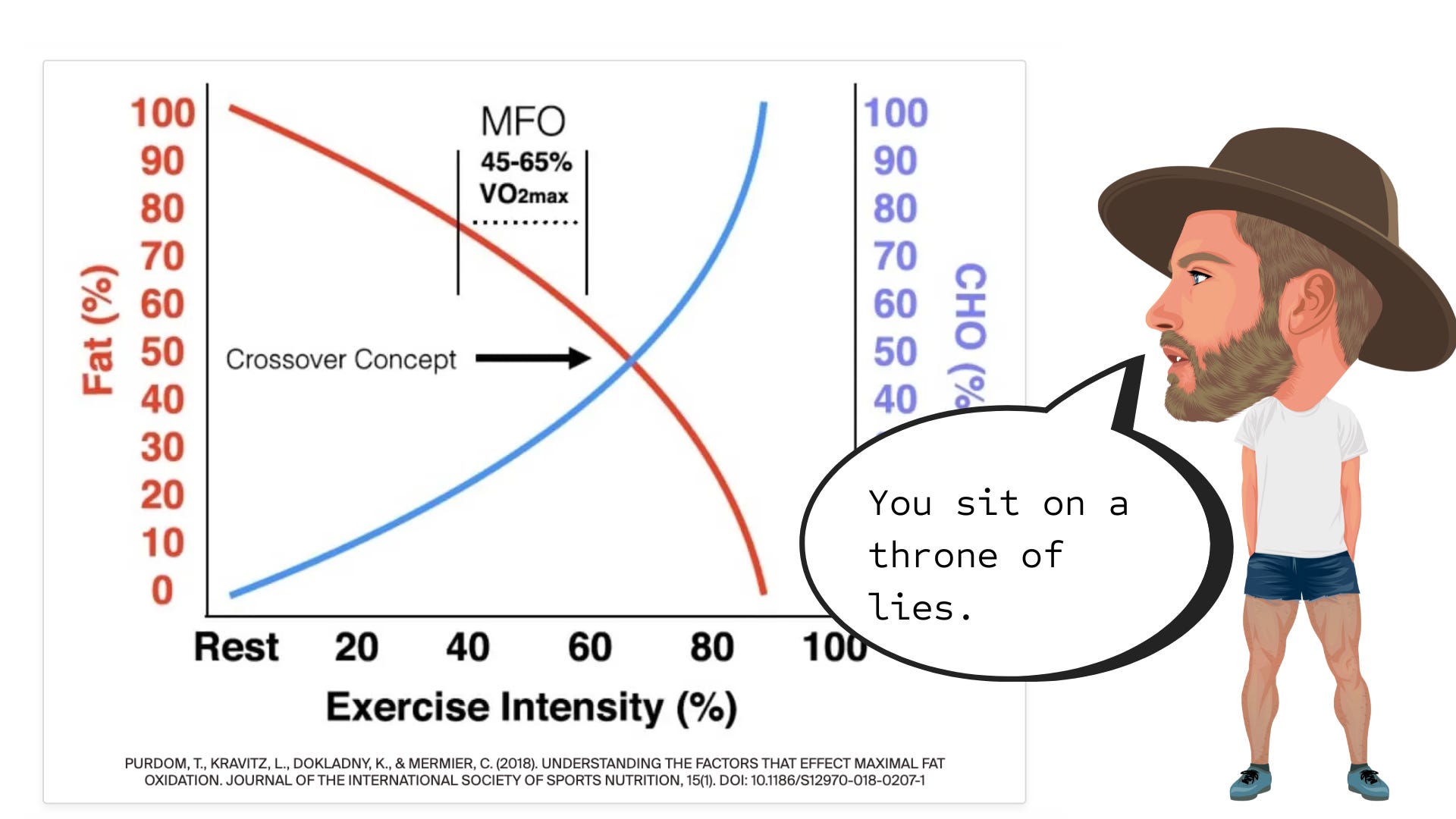
When I was growing up in the cycling world, many, many cyclists talked themselves into doing four-plus-hour rides fasted, eating bacon and boiled eggs when they weren’t, and otherwise trying to optimize their ‘fat-burning’ capacity after leading lights like Tim Noakes, Joe Friel, and other passionate diet truthers came out preaching about the goodness of our Substrate Savior Fat and the evils of the Carbohydrate Devil!
It turns out it was all bullshit, though. Oops.
Like so many things, an entire generation of athletes got swept up into a training fad because one person misread a chart from a study, said some crazy shit, and then everyone who listened to them afterward didn’t bother looking critically at the study this zealot cited to justify their crazy. Time is a flat circle.
Here’s the bottom line:
At all meaningful exercise intensities, cyclists, even ‘fat adapted’ cyclists, burn more carbohydrates than they do fat as a percentage of their substrate utilization. In other words, the much worshipped ‘cross-over point’ isn’t real.
The fitter an athlete is, the better they burn fat, but even the fittest athlete still burns more carbohydrates than fat as a percentage of the total energy required for exercise at all meaningful exercise intensities.
Training well (doing an individually appropriate amount of volume and intensity) improves an athlete's fat-burning ability, not eating fat and avoiding carbs.
So, instead of trying to hack ‘fat burning’ through bizarre nutritional practices, athletes would be better served to fuel their training window and training well. That last sentence might seem banal, but if you feel that way, you’re only revealing your training privilege because many, many athletes ruined their careers and hated every second spent pedaling diligently, depriving themselves of carbohydrates chasing the golden calf of fat burning.
If you want me to show my work for this, go ahead and say so in the comments, and I’ll make a separate post. Otherwise, blankly accept this statement and get faster without questioning me.

“Carbs make me fat.”
I once worked with an athlete who regularly did not eat enough carbohydrates in their eating window to properly fuel training, started doing so, gained some weight, lost their bananas and promptly fired me.
When I asked them why, it was hard keeping a straight face when they said,’ All these carbs are making me gain weight.” Like hell they are.
Most of the time, nailing the training eating window means eating ~200 kcal/hour of training. 200 calories is nothing! 200 kcal is what you get if you look at food in a restaurant. It’s one IPA. It’s a serving of chips. It’s ‘accidentally’ eating something off your kid's plate.
Look, my beef is this - all the people who blame carbs for weight gain are not bringing anywhere close to the same level of scrutiny to their diet as a whole as they are to what they eat during training. These are the people who gain a couple of pounds and blame the gels (and their coach!) they take during their 90-minute high-intensity workout while they’re out with their wife at a fancy restaurant drinking their second glass of wine (~150 kcal/glass at least) while they mull over what dessert they’ll split (even if they split the dessert, that souffle is at least 300 kcal/person).
In other words, they scapegoat carbs for weight gain, blaming the energy they consume when they need energy the most while willfully discounting the role the rest of their diet plays in the reason their bibs seem to fit tighter.

Training to Eat, not Eating to Train
While the aforementioned cherry-picking drives me nuts, I’m sympathetic to this logic of athletes blaming carbs for weight gain because it reveals something many athletes don’t like to admit - they’re not eating to train, they’re training to eat.
Let’s not pretend that after a few long rides, you haven’t looked at how many kcals you’ve burned and thought, ‘Oh wow, I could have 20 Miller Lites and not gain a pound.” Or three big Macs. Or whatever your thing is.
The point is that many cyclists have fat kid hearts but stay skinny by deliberately and consistently underfueling vigorous exercise so they can demolish buffet tables, baked goods, six packs, or whatever else is unfortunate enough to get into their line of sight post-ride.
Besides your famine-evolved body loving to demolish stacks of highly processed calorically dense nonsense, being able to eat criminal volumes of ‘bad’ food while remaining skinny is one of the cyclists' few party tricks. For better or worse, many cyclists enjoy the perverse flex of eating like a clown around bewildered, tubby normies and fielding comments like, ‘Where does it all go?” or ‘You’re so skinny; how can you eat like that?”
To anyone else, those comments are completely innocuous, but to a cyclist, those sorts of unsolicited statements are proof that they’ve won a victory of sorts - successfully depriving themselves enough to be painfully thin while paradoxically eating enough to draw attention at a restaurant.
But…you’d be faster if you ate carbs
Whatever the rationale behind carb phobia, the real loser at the end of the day is your legs. You’ll never need varicose vein surgery if you keep fueling like you’re trying to fit into your prom dress.
So, how many carbs do you need? I’m so glad you asked.
The Nutritional Training Window = ‘The Window.’The training window is a concept best expressed by my colleague Joe Howdyshell in a book he’s refused to release to the world because it’s phenomenal. He doesn’t want to earn too much money and believes in communism and dying poor. Anyway, here’s how to eat before, during, and after training to maximize your performance, adaptation, and happiness.
Now, if you don’t feel like reading this but want to take advantage of the information, I built a nutritional calculator for you here with all the information. Input a few personal details, and voilà, you’ll know how and what to eat and when. You’re welcome.
Before Training
Make sure "storage tanks" of glycogen are filled before the effort.
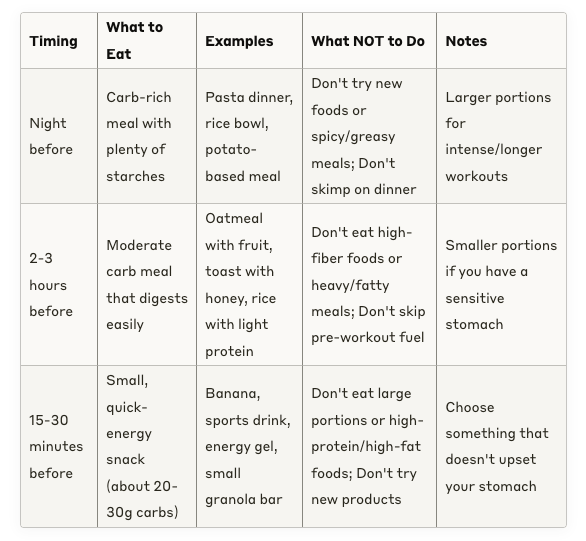
For technically-minded athletes: Aim for 7-12g carbohydrate/kg body weight over 24 hours before significant events; 1-4g/kg for the pre-event dinner; 1-4g/kg for the meal 2-3 hours pre-workout (higher end for longer workouts); 0.25-0.5g/kg for the 15-30 minute pre-workout snack.
During Training
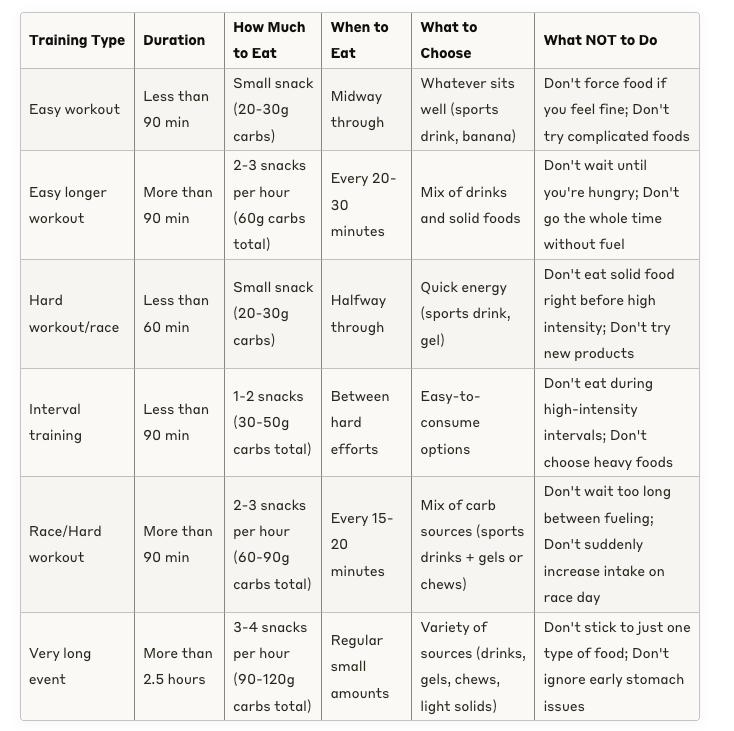
For technically minded athletes: For exercise >90 minutes, target 30-60g carbs/hour for beginners; 60-90g carbs/hour for experienced athletes with trained guts; and up to 90-120g carbs/hour for ultra-endurance events (using 2:1 glucose:fructose ratio when exceeding 60g/hour). For high-intensity interval workouts, aim for 0.5-0.8g carbs/kg/hour.
Common Mistakes to Avoid:
Waiting until you're hungry or tired to eat (by then, it's too late)
Trying new foods or supplements on race day
Drinking sports drinks when water would be sufficient (shorter/easier workouts)
Not having a backup plan if your regular food doesn't work out
Copying exactly what elite athletes do without testing it for yourself
Overthinking nutrition and making it more complicated than necessary
After Training
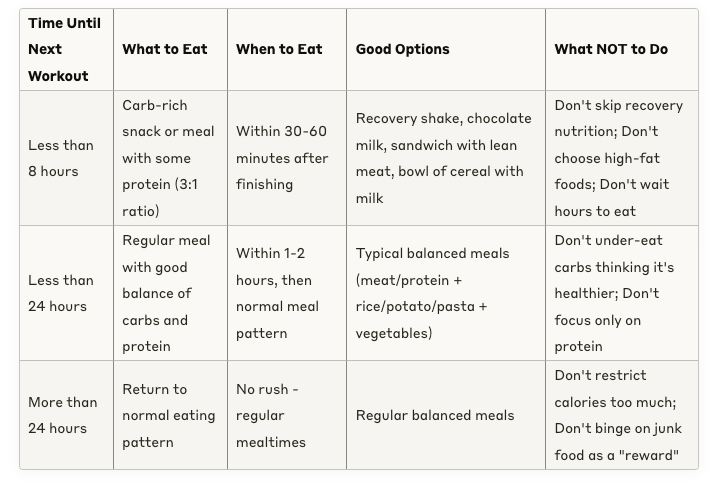
For technically-minded athletes: For quick recovery (<8 hours until next session), consume 1-1.2g carbohydrate/kg body weight plus 0.3-0.4g protein/kg within the first hour; for <24 hours, aim for 1g carbs/kg across multiple meals over 3-4 hours post-exercise with 0.25g protein/kg; maintain a carb:protein ratio of approximately 3:1 to 4:1 for optimal glycogen synthesis.
Tips for Eating During Exercise:
Start with smaller amounts and gradually increase as your body adapts
Stay hydrated - drink 12-24oz (350-700ml) of fluid per hour
Practice your eating plan during training, not for the first time on race day
Everyone's body is different - find what works for you through trial and error
About the Recovery Window:
Your body replaces energy stores fastest in the first 30-60 minutes after exercise
This quick refueling is most important when you have another workout coming soon
A mix of carbs with some protein works better than just carbs alone
Liquid options (shakes, smoothies) can be easier to consume when you're not hungry after hard exercise
Remember, N=1
After all those recommendations, I have some bad news - you can’t shut your brain off and blindly follow the suggestions if you want to optimize things:
Pay attention to how you feel during and after workouts to fine-tune your eating plan
Try keeping notes about what you eat and how your workouts go
For personalized advice, consider talking to a sports nutritionist
These guidelines work for most endurance sports but may need adjustments for your specific activity
Thanks for reading Slow, Mid, 38s! This post is public so feel free to share it.