One of the big points I’m always at pains to make that athletes ignore completely but pretend to acknowledge is that training is not racing. As in, how you’re performing in training, the results on your latest power test, say, have less to do with your race results than you’d like to think.
The average beginner or intermediate athlete thinks training goes something like this:
1. Ride lots really hard.
2. FTP goes up.
3. Sign up for the race.
4. Ride away from everyone.
5. Feel good about yourself.
6. Finally happy.
7. Girls/guys care about me.
8. Reproduce.
Of course, that stepwise progression is a child’s idea of what training looks like, but that doesn’t stop plenty of adults who should know better from widely holding it. Though I just listed many things worth exploring, the heart of the delusion in those steps isn’t the sixth step of becoming happy; it’s thinking that getting fitter translates directly to a good race result.
my internet just got disconnected I’m typing this from the public library please give me something for making your life better I can’t do this forever.
I raise this topic because many athletes' frustration with the training process arises from the disconnect between the numbers they rely on to gauge their training and expectations and what actually happens when the gun goes off. Athletes, to put it mildly, are often devastated to find that months of consistent training and a 10% increase in FTP only result in getting dropped slightly deeper into the race than years past.
And why is that? Because training is not racing. Racing is:
1. Conserving energy
2. Great positioning
3. Tactics
4. Patience
5. Willingness to suffer
6. Risk-taking
7. Nutritional execution
8. Pace changes
9. Logistical execution
10. Recon
11. Mental Game
12. Etc.
I’ve said all this before, but like many of my statements, it lacks a scientific basis and relies entirely on persuasion techniques and being loud, not facts and data.
Well, thanks to an athlete last weekend, I finally have ONE data point that 100% proves that what I’m saying isn’t an elaborate excuse for giving my athletes shit workouts that make them slow.
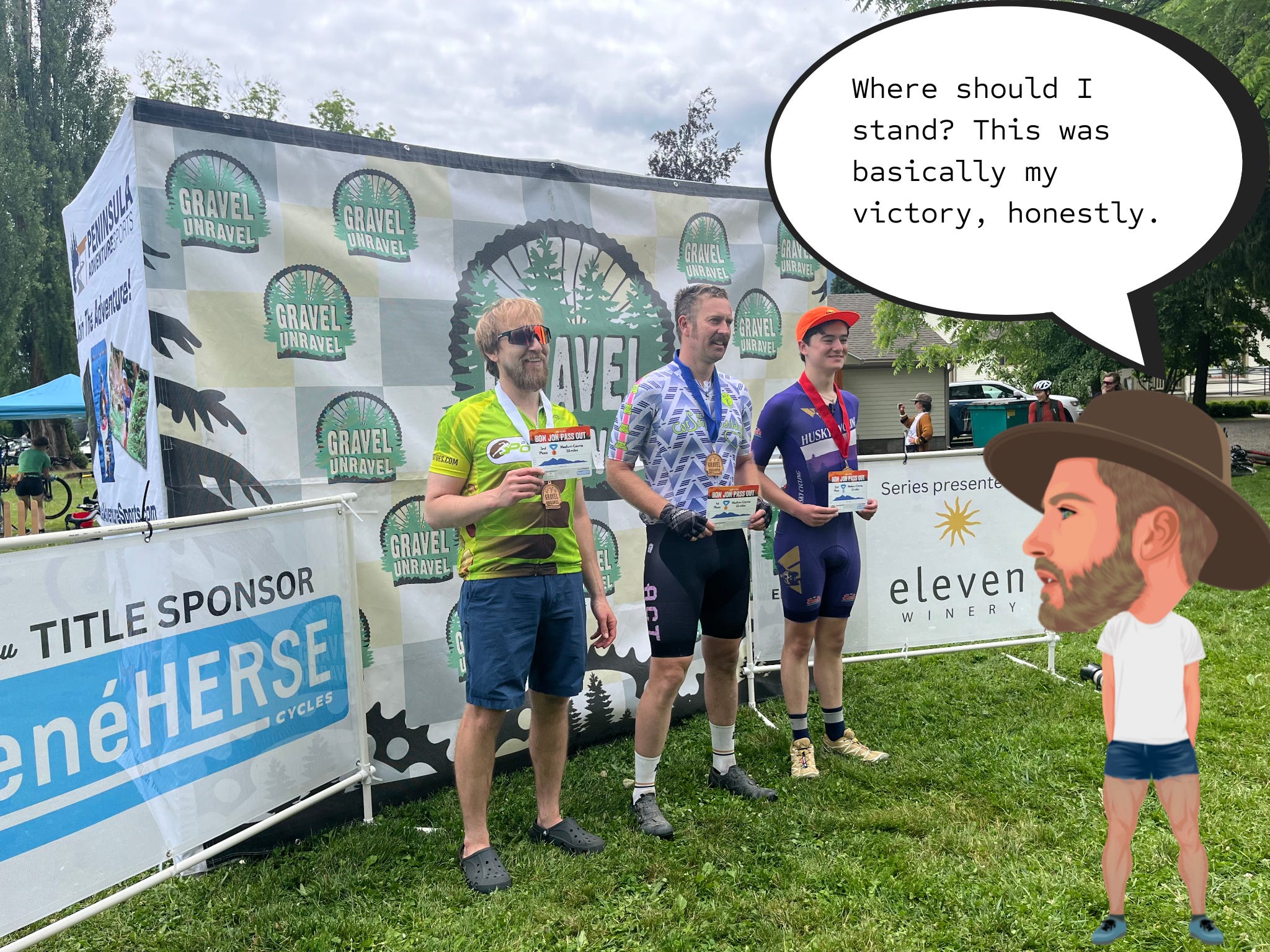
Lessons from the Bon Jon Pass Out 2025 Medium Course Overall Winner
Never heard of Bon Jon Pass Out 20205 Medium Overall Course winner, much less the race Bon Jon Pass out?
It sounds like a you problem, not a me problem. It’s 2025, and the last thing I’m going to do is use my limited emotional gravel labor to educate you on one of the Pacific Northwest’s most prestigious local second-tier gravel races. Do better.
Anyway, the winner of the Medium course this year, Forest Hietpas, (not sure how to pronounced his last name I think it’s Danish which I wouldn’t want in my mouth any more than other foul Scandinavian things), a Gravel God Cycling athlete (everything he is he owes to me he’d be nothing without me and if you want to be something you should apply for coaching all of my ex athletes are losers) won this year.
[please clap]
And how did he do it? Here’s what didn’t help him win:
1. His FTP
2. His weight.
3. His stress levels.
4. His responsibilities.
5. His general life outlook.
Instead, he won because of:
1. Smart Tactics
2. Technical ability
3. Willingness to suffer
4. Mental Game
Read those lists again.
Forest DID NOT win because he possessed any of the physical characteristics cyclists typically rely on to win races or get good results - he is actually shockingly slow and thicc right now.
Instead, he won based on a clutch of racing-related abilities that can’t be measured with a power meter or crammed into some number everyone can compare themselves to.
Now, I’d like to qualify one thing I’ve already said, so I keep the comment section of my substack to a dull roar.
I realize my entire piece rests on the idea that Forest didn’t win the race because of his FTP, but I also recognize that’s slightly misleading because it sort of implies he won in spite of his power, which isn’t true. His power numbers may have been disappointing to him (amongst much else Jesus Christ man you won can you just be happy for once in your life?), but they were also obviously plenty good enough to give him a chance to win. In other words, he had the power necessary to win, even if it wasn’t sufficient to win.
Put another way, the power Forest brought to one of the most important races of the year, the Bon Jon Pass Out 20205 Medium Overall Course, met the table stakes required to play the game. From a fitness perspective, he didn’t have an overwhelming hand, but he also wasn’t pack fodder either, which is to say that he found himself in a position in the peloton that most racers find themselves in - they have a chance at a good result, but no guarantee.
Requiem for a Forest
If you thought the movie Requiem for a Dream was scary, you’ve never been inside Forest’s head. He’s never been one to lack enthusiasm or accused of brevity, but for educational purposes, good luck finding someone better to learn about racing strategy.
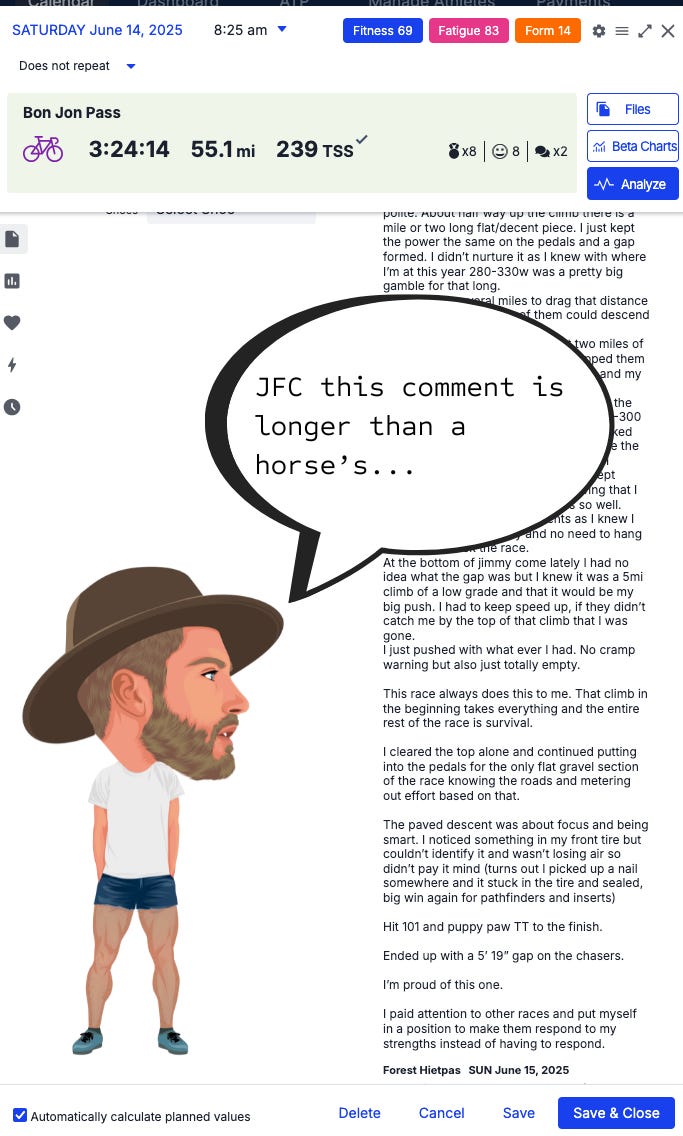
Let’s take a peek at his TrainingPeaks file and see what we can learn. I will assign each comment from his post activity race file commentary to a race-specific area and note that in parentheses.
“At the bottom of the climb, I was uncomfortable in the group due to a distinct lack of handling ability.”
(Tactical)
Forest didn’t start the race and just put his head down. When the race starts, he’s scanning the peloton and assessing strength and weakness immediately, in contrast to lots of racers who are too busy trying to find an angle to launch a Hail Mary attack from the gun.
“By riding at 300w, I ended up at the front and just kept it around that until the end of the first gravel section when I heard the heavy breathing behind me begin to dwindle.”
(Fitness)
The power necessary to hang in the front group was ~300, or roughly 3.5 w/kg.
Those of you with adult film size genitals need not quietly smirk at this number and dismiss everything else he says, because the same tactics happen in your races, just faster.
“Last year winner who was breathing really hard and a bigger guy and a 20 year old skinny kid. I led introductions and was intentionally chatty and polite.”
(Tactics (Machiavellian))
This is gold. After making the front group, Forest lands a hammer blow against his adversaries by being social. This is a masterstroke in tactics because:
1. The ability to talk after a hard effort implicitly signals that you weren’t that bothered by the effort (Unlike, say, the guy who was breathing hard).
2. It disarms everyone when you’re friendly in a race situation when everyone is supposed to be super serious and standoffish because you’re racing. Of course, none of this is genuine in a race and is always meant to lull your rivals into complacency.
“About halfway up the climb, there is a mile or two long flat/decent piece. I just kept the power the same on the pedals, and a gap formed.”
(Technical;tactics)
Fascinating. So right after softening up his opponents with fake friendly gestures, Forest casually starts booling a bit into some low-key technical sections.
Note that he said, ‘I just kept the power the same,’ which tells you that this wasn’t a specific ‘attack’, per se, but just steadily keeping the pace high in demanding enough places that it asks questions without asking questions. If this non-question question reveals anything, i.e., a gap opens up, etc., it’s HUGELY telling.
Note that this is an underrated race tactic - not specifically testing your opponents with an attack, but just keeping it steady and confidently hitting a corner and seeing if any unexpected gaps open up that might reveal weakness.
“It took them several miles to drag that distance back, but I knew neither of them could descend very well.”
(Technical)
Small aside here - this happens in gravel racing far more than you’d expect. Riders with identical fitness have enormous gaps open up because they open up three wheel lengths per turn, and after thirty-plus turns, they’re quite literally out of sight around the corner.
“We chatted a bit more for the last two miles of the climb, and then I immediately gapped them on the descent. It was foggy and cold, and my legs were sending warning signals.”
(Tactics; (Machiavellian))
Another veteran move. Realize that Forest has just casually opened up meaningful gaps while descending which reveals a huge weakness in his opponent but once rejoined (with no small effort on the part of his rivals) he merely resumes the conversation, almost as if this significant thing didn’t happen, which I can assure you is deeply unsettling when you’re the one getting dropped.
“That descent is followed immediately by the steepest climbs of the day. I pushed 280-300 and could feel cramps threatening. I worked through them and remained calm. I could see the two chasers about 10 seconds back as I summited Bon Jon. From there, I just kept steady pressure on the pedals, knowing that I had the advantage of knowing the roads so well. I didn’t go all out on the descents as I knew I needed a bit of recovery and no need to hang it all out and risk the race.”
(Mental Game, Risk Taking, Tactics)
First off, Forest knew the course well (because he lives in the area), but in some sense that doesn’t matter because in nearly every race course there’s enough information beforehand to have some general idea what to expect and how to pace.
Second, he could feel that his waning conditions (the cramps), but didn’t join with thoughts of panic (Mental game) because it wouldn’t help.
Third, he already knew he could descend better than the chasers AND that he needed to recover (Risk Taking, Tactics), so he didn’t push the limits and needlessly risk a crash or add extra strain to an already stretched body.
“At the bottom of Jimmy Come Lately, I had no idea what the gap was, but I knew it was a 5-mile climb of a low grade and that it would be my big push. I had to keep up speed; if they didn’t catch me by the top of that climb, I was gone. I just pushed with whatever I had. No cramp warning, but also just totally empty.”
(Tactics, Willingness to Suffer, Risk Taking)
Forest knew where he needed to push to hold on and dumped his last remaining matches into the effort. (Tactics/Risk Taking)
While my general low view of suffering as a strategy to get fit is well known, in racing, and especially in these positions, you need to overdose on Vitamin P (pain) in many cases if you want to win the critical moments.
“I cleared the top alone and continued putting into the pedals for the only flat gravel section of the race, knowing the roads and metering out effort based on that. The paved descent was about focus and being smart.
I noticed something in my front tire but couldn’t identify it and wasn’t losing air, so I didn’t pay it mind (turns out I picked up a nail somewhere and it stuck in the tire and sealed, big win again for pathfinders and inserts). Hit 101 and puppy paw TT to the finish. Ended up with a 5’ 19” gap on the chasers.”
(Tactics, Risk Taking, Mental game)
At this point, I’m getting tired of labeling everything tactics and risk-taking, but this comment remains true because he had ‘passed the test’ of suffering to keep the power high, such that he kept the lead over the top and realized, again, that he didn’t need to go for a downhill KOM with a blown body and a lead.
Not hitting the panic button when he was basically assured of a victory that could have been undermined with a slow (or fast) leak is a testament to grace under pressure and not allowing panic to set in.
Takeaways
While Forest selfishly writes these write-ups for his forthcoming memoirs, even more experienced, analytically minded riders could learn a lot from his thought process.
Simply put, yeah, it’s great to win if you’re simply that much stronger than everyone else, but for most racers, their best results are going to happen with average to OK fitness combined with some combination of:
1. Conserving energy
2. Great positioning
3. Tactics
4. Patience
5. Willingness to suffer
6. Risk-taking
7. Nutritional execution
8. Pace changes
9. Logistical execution
10. Recon
11. Mental Game
12. Etc.
Forest’s thumping win at Bon Jon Pass Out 2025 Medium Course clearly demonstrates what these race attributes look like in practice and what can be achieved with fitness that doesn’t even make the racer proud.
So, next time you go out to race, remember Forest’s example, pick one of those race factors, and work on those instead of just trying to beat everyone into submission with unthinking pedaling.
And if you’ve scoffed at my advice before and are just now realizing the error of your ways, I’ll find it easier to forgive you if you buy me a few 50th Anniversary golden Miller tall boys.
Honestly, how much effort does it take to share a post? Would it kill you to do something for me for once?