
Because I’m an amazing, thoughtful coach who actually cares about his athletes and doesn’t skip asking what their goals are for 2026, I’m getting a lot of replies from athletes right now about their hopes and dreams. If I were a good person, I might be feeling inspired by their ambition and even excited to help them achieve their goals, but what I’m overwhelming left with after reading about most of their ‘goals’ for 2026 is a desire to go straight to my garage, pick up a crow bar, and throw it as hard as I can against a wall, repeatedly.
Why am I throwing crowbars again? Every winter, I ask my athletes what they want next season. And every year, I brace myself for impact. Because nothing tests my self-control more than reading 20 versions of “I want to get stronger.” It’s like asking a restaurant what they serve and hearing, “Food.” Here’s a sample of what I received in response to the question, What are your goals for 2026:
“I want to build strength and muscle mass.”
“I want to have a good ride at Unbound next year.”
“I want to prioritize fun rather than structure.”
“I want to beat my Susan in the local race series.”
“I want to lose weight.”
“I want to stop the effects of aging.”
Now, you might have read this list and thought to yourself, “Man, what is Matti going on about? These are great goals! If I’m honest, I want to lose weight so I can also beat Susan (that bitch) at the local race series!”
OK. Here’s where I’m coming from—you may, like me, find some (but definitely NOT all—Susan isn’t even that good, set your sights higher!) of these goals inspiring and worthy, but every goal on that list is minimally poorly formulated and maximally not even worth the oxygen it takes to say them.
If you gave me money I’d stop begging for it.
Motivation ≠ Goal
A widely accepted definition of a goal is the direction you want to go. Simple, isn’t it?
Well, I think that’s garbage. That’s not a goal, that’s motivation masquerading as a goal.
You see, most of the time when people think they’re talking about their goals, they’re actually talking about their motivation. Motivation is the emotional force, or the why behind what they’re doing. A goal, by contrast, is a specific, measurable, achievable, realistic, risky, time-bound thing they want to accomplish.
For example, saying “I want to eat better ” sounds like they’ve stated a goal, but it’s actually a disguised motivation. ≠ I want to eat better, which means I want to look better naked, or drop weight so my w/kg improves, all so you can get laid more, of course.
So what’s the problem with conflating motivation with a goal? Motivation is not a goal; it’s the activation energy required to want to start the actions toward a goal. The insidious thing about motivation is that if you’re not careful, the initial jolt of motivation becomes the only thing you do.
What does this look like in practice? Watching motivational reels on social media for hours, but doing nothing. Buying things—a bike, a gym membership, a book—that enable you to take the right action, but you never take them. The source of that motivational hit varies, but the end result is the same—no action.
Feeling inspired is a necessary condition for doing something, but it isn’t sufficient to consistently perform the actions required to accomplish the goal. If you want to eventually disappoint yourself and achieve your goal, you will eventually need to stop listening to pump-up videos and act.
The best shortcut to remember this, I’m going to blatantly rip off from Chris Williamson (of podcasting fame):
Do the thing.
The thing is, whatever actions you need to take to get you closer to your goal (in contrast to motivation, which is what you need to start your goal).
But I’m getting ahead of myself. The important thing to remember is that motivation, the reason you start doing something, is not the same as a well-constructed goal.
Time for a bathroom break. When you get back, we’ll break down what a shitty goal looks like.

The Anatomy of a Shitty Goal
Because people remember negative things more than positive things, let’s break down why “I want to have a good ride at Unbound next year” is a shitty goal by using the inverse of a widely recognized goal framework, SMART:
(Not )Specific
“Have a good ride” means nothing. Does “a good ride” mean winning, not finishing last, beating the sun, not bonking, not crying? In its current form, this is meaningless.
Why would someone specify such a non-specific goal? Honestly, because they’re lazy.
While that may be understandable, it’s not excusable, and if someone sends me such a nonspecific, half-assed goal, I will use all my willpower not to fire them on the spot and tell all their friends how tiny their FTP is.
I have such a strong reaction to this because to this day I can’t understand how people can be so goddamn careless and blase about their goals. It makes me want to shake them.
It’s like, it’s YOUR goals. It’s YOUR life. You’ve only got one, the clock is ticking, and your big ambition for your one precious life in 2026 is “have a good ride”?
Get the fuck out of here with that.
(Not) Measurable
“Have a good ride” can’t be measured. It sounds good, but there’s no objective or subjective criterion with which to assess the performance.
Instead of ‘good ride’, you’d want to put something measurable like “Finish under 14 hours,” which sounds somewhat pointless except that now you can measure success and failure. In this case, if you ride Unbound in more than 14 hours, you’re a failure (no, really, you are a failure and you should quit), and if you ride Unbound in under 14 hours, then you succeed.
Why wouldn’t people make their goals measurable? Easy - if your goal can’t be measured, then you can’t fail. Sounds great, right?
I’m sure you’re clever enough to see that while depriving your goal of measurement means you can’t fail, it simultaneously means you can never succeed.
And this is the bumper sticker, tatto-worthy insight about being able to measure your goals—if you can’t measure your goal’s success or failure, you’re not special; you’re a coward, too chickenshit to put yourself on the line. You think you’re saving yourself from failure, but all you’re doing is ensuring you remain mediocre.
(Not) Achievable
Because we can’t measure ‘good’, it’s hard to say if it’s achievable given your current state, but let’s say we’ve resolved that issue and have developed a criterion to assess the performance. Great.
What it gets at is whether the difference between what you can do now and what you want to do is possible.
In general, I think it's really important to constrain your ambition. For example, if “I want to have a good ride at Unbound” turns into “I want to beat Keegan Swenson at Unbound 2026” (when you still haven’t beat the sun), your goal has improved because it’s not specific and measurable, but it’s not realistic.
Now, you might say, take your foot off the throat of my dreams, bro, don’t tell me what I can and can’t do, and you’d be 100% right and should tell me to kick rocks if I immediately dismiss your ultimate goal. However, I wouldn’t do that because I don’t believe in you; I’d do that because not making the goal realistic harms your chances of achieving it.
Why?
We know that if you drown mice, most will give up and let themselves drown in less than 10 minutes. However, if you give the mice a little platform to rest on intermittently (before they give up the first time), most mice will keep on treading water long after mice that don’t get any platform.
You may not be a mouse, but your reward circuitry isn’t that different. If your actions make you feel like you’re moving closer to a realistic goal, you’ll receive a little bit of chemical (dopamine, I think) reinforcement every time you do something to move you closer to that goal.
But you’ll only get that if you think your efforts matter. If your goal (say, not drowning) is too difficult (you’re never given a platform to rest, i.e., rewarded for your efforts), internally you will say ‘fuck it’ and give up (unless you’re unwell like my friend Airik, but you’re not Airik).
So, for your own good, it really is important that your goal is realistic within a certain time frame (about which more soon).
Relevant (Maybe reason is better?)
Relevant just asks whether the goal connects to your ‘why,’ the deeper reason you want to do something.
In this case, I’d argue that “I want to have a good ride at Unbound next year” is relevant because wanting to ride 200 miles fast at a highly competitive, prestigious event implies, even if it doesn’t directly articulate, the deeper reason(s) behind the goal.
So what’s the relevance/reason of having a good ride at Unbound?
That can be tough to break down, but a great method is to run it through the 5 Whys exercise: State the goal, and then ask yourself why. Repeat 5 times.
For example:
Why do you want to have a good ride at Unbound? Because I want to challenge myself.
Why do you want to challenge yourself? Because I want to improve.
Why do you want to improve? Because I could be better than I am now.
Why do you want to be better than you are now? I want to prove to myself that someone with a full-time job and a family can be fast.
Why do you want to prove that to yourself? Because I want to feel capable and alive, not inherently limited by my life constraints.
You can go further, of course, and I encourage you to do so, but I suggest running each of these goals through this process because it’ll inevitably reveal a lot about your core motivation.
You’ll find that the answers to the first three questions are going to be kind of a yawn, but by the time you get to the fourth and fifth questions, you’re going to feel like you’re on a therapist’s couch, struggling to come up with the language to justify the reasons you’ve coasted on for your years without questioning.
Another thing you’ll notice is that your goals, if they’re externally aligned or focused on something you don’t have control over, will quickly become uncomfortable.
For example:
Why do you want to be Keegan Swenson at Unbound? Because he’s the best.
Why do you want to be the best? Because then I can get paid to ride.
Why do you want to get paid to ride? Because other people will think I’m cool.
Why do you want other people to think you’re cool? (uh oh!) Because then they’ll like me.
Why do you want to be liked? Because I don’t feel like I’m enough as I am right now.
Wooooooooooo!!! That shit got gnarly real fast, and I didn’t even reveal the answers to asking a sixth or seventh time! If you do this and find that the answer to your fifth why is something like “Because I don’t feel like I’m enough as I am right now,” I highly suggest that you keep going. The answer to that question is quietly steering your life, and you'd better make sure it’s taking you where you want to go.
And look, I’m not going to come out and say that external goals are wrong and internal goals are better, but I will borrow from my good buddy Andrew Huberman (yes, the guy with the commitment issues and big podcast), who says:
“Do what you want, but know what you’re doing.”
Preach. External goals, even if they’re shallow or instrumental, can be great, but make sure you know what’s pulling the strings of your puppet because plenty of people spend the best years of their lives spending all their time (IMPORTANT VARIABLE) pursuing something they’re five whys away from not caring about.
(not) Risky
Risky is not part of the SMART acronym because doing so would make it SMARRT, which wouldn’t sound smart because it misspells smart. I don’t care—I’m adding another letter to the acronym because no goal is complete without it.
The extra R here stands for Risky. Risky just means—is this goal going to push you or not? Does it sound slightly insane when you say it out loud, or is it so in reach that it barely qualifies as a goal at all?
In my observation, many times, athletes do not make their goals crazy enough. For every athlete I’ve seen tell me they “wanted to be the next Peter Sagan” (this happened), you get ten athletes who are like, “I want to finish Unbound for the tenth time,” which is an unforgivably stupid goal.
Your ancestors did not struggle and grind for thousands of generations just so you could do the same thing you’ve always done and call it a victory. And actually, fuck your ancestors - YOU did not go through everything you’ve gone through to spend another year doing the same shit and allowing yourself to feel good about it. It’s beneath you.
If you’re interested in feeling alive and also getting much closer to what you could be, then your goal should be somewhat risky, maybe even unlikely enough that some might call it crazy. In fact, if people don’t think your goal is crazy, that’s a sure sign that you’re not being risky enough.
I realize that everything in life isn’t about achievement, that technically speaking, we’re human beings, not human doings, and that there are more elevated aspirations in life than getting rich, famous, or fast (just not if you’re American), but I’d be remiss if I didn’t come out and plainly lay out the reality—extreme results require extreme action.
The obvious point here is that if you really want to stand out, it’s not going to happen for you with moderate, inconsistent actions. But those are actions. While a lot of people can appreciate that extreme actions can produce extreme results, few realize that unless your goals are extreme, there’s no way in hell your actions are going to be extreme. Modest ambitions aren’t going to get you out of bed before work or gritting your way through the last hour of a five-hour ride. The results you want should be RISKY!
Will you probably fall short of it? Sure. Would you feel bad if you did? Who cares. Will others laugh at me if I don’t achieve it? See previous answer.
Look, the rationale behind the Risky acronym isn’t that deep, but it is important - you are going to die. And long before you die, you’re going to get old. And long before you get old, your time, priorities, and resources are probably going to fatally limit or constrain what you could realistically do in sport, and later on, no matter how much money you have or how many peptides from Mexico you inject, you will not get those chances back.
Do your future self a favor and stop dreaming like a pussy, OK?
Anyway, if we’re going to make this athletes’ Unbound goal a little risky, let’s put their performance on the podium in their age group. That’s tough in essentially any category, but it’s also not unthinkable. We’re getting closer to a proper goal.
Time-Bound
Time-bound just means when you’re going to finish this goal. The example goal, “I want to have a good ride at Unbound next year,” is time-bound - the athlete will do this by (and at!) 2026 Unbound 200.
Why bother smuggling this variable into our goal framework? Without a deadline on your goal, you’ll never do it—you’ll put it off.
While not every ‘law’ you learn about in physics or psychology directly impacts you, Parkinson’s Law, the time it takes to do something expands to fill the time alotted, definitely applies to almost everyone. Put another way, if you don’t give your goal an end date, if you supply yourself with too much time, the demand to act goes down. Conversely, if you give yourself very little time to do something, the demand to act goes up.
Yes, the laws of supply and demand apply to your goals, and I’ll give you one guess as to what usually happens when people reduce their supply of time to do something - yep, it gets done. Why? Because when you decrease the time provided to get something done that you value, you’re incentivized to act more quickly to make it happen. Incentivization to act faster is called urgency.
Urgency - feeling a pressure to act faster - is what separates average performers from high performers. The dirty little secret about urgency is that most people’s objections to not doing it - to not Do The Thing - are bullshit. Most people’s reason for not doing the thing now boils down to it’s easier to do anything else but the thing.
Caveat: Your body doesn’t adapt to training on your timeline. For example, riding 200 miles your first day back after a season break would qualify as urgency, but it wouldn’t be effective. It’s inarguable that there are actions you can’t necessarily ‘speed up.’
But, honestly, that caveat and all those details can all pound sand because the core reason to set aggressive time constraints on your goals is summarized in a Charles Bukowski quote:
“I was waiting for something extraordinary to happen, but as the years went by I realised nothing ever did unless I caused it.”
Yes. YES! If you want to be great, it’s not going to happen with you lying around waiting for things to happen to you - you need to light a fire under your ass.
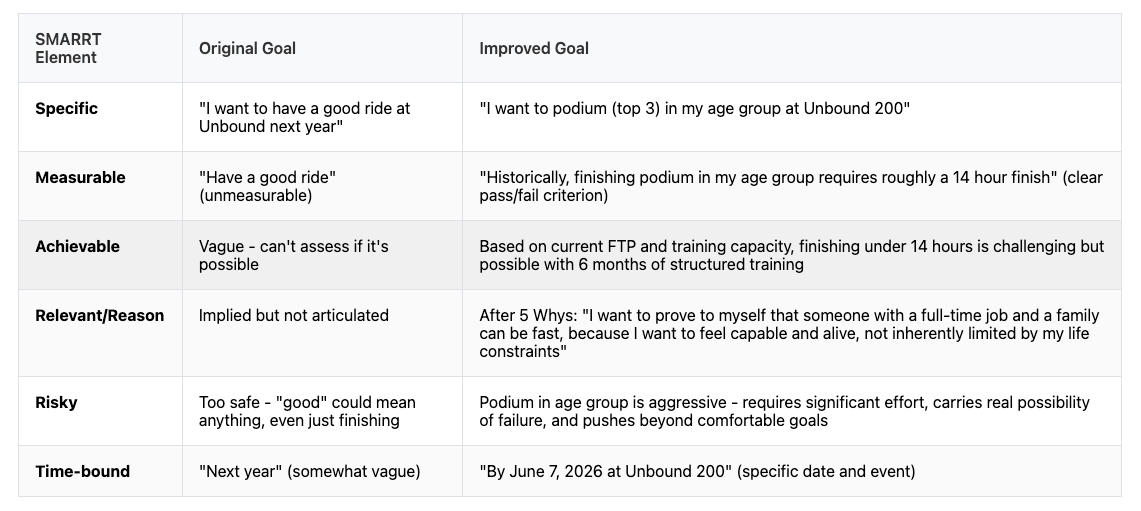
Goal Update
As a reminder, this is where we started:
Original: “I want to have a good ride at Unbound next year.”
And this is where we ended up:
Improved: “I will podium (top 3) in my age group at the Unbound 200 on June 7, 2026, by finishing in under 14 hours, which will prove to myself that someone with a full-time job and family can compete at a high level and feel capable and alive rather than limited by life constraints.”
Now THAT is a goal. We really had to fight for that one! I don’t know about you, but I kinda want a MeeLahr Lite after all that. There’s just one problem - we still don’t have a plan.
P.S.
I have athlete spots available.. If you know someone slow (who would like to be fast), have them email me at gravelgodcoaching@gmail.com. 🙏🏻