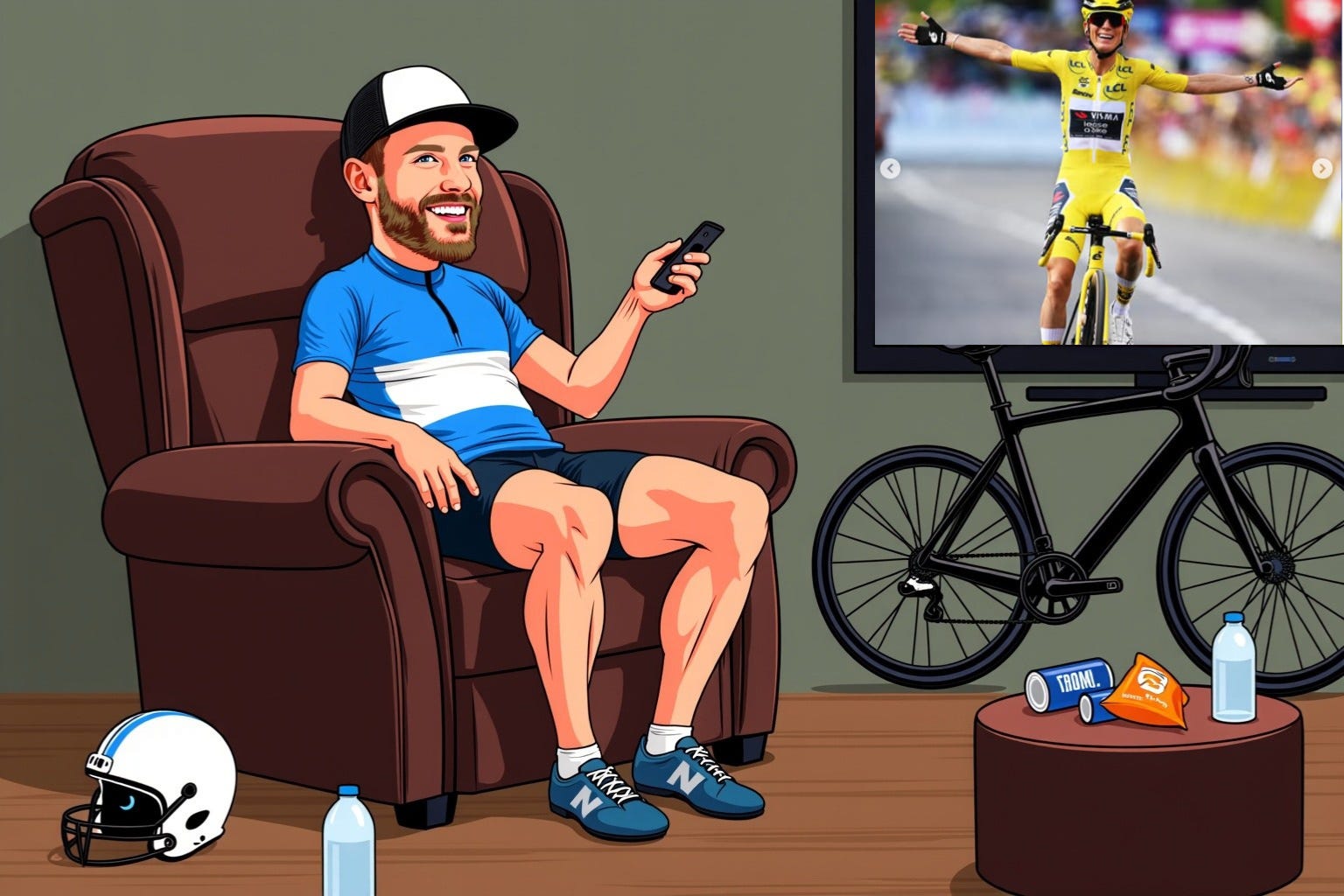
Pauline Ferrand-Prévot (pronounced Feh-RAHN Pray-VOH, in case you want to learn French words for some reason) won the 2025 Tour de France Femmes (the Tour de France for women) with a few climbing demonstrations that the internet was wild with accusations of doping and other underhanded performance-enhancing interventions like…weight loss.
Between two well-spaced races - Paris-Roubaix and the Tour - she systematically cut weight to prepare for a couple of alpine horror shows (hello, Col de la Madeleine) that make or break a GC in the Tour De France Femmes by leaning on the old school ‘don’t eat anything untl you think you’re going to pass out and then eat a cube of cheese’ diet, or, a professional nutritionist and chef.
From Ferrand-Prévot’s perspective, a woman dieting for performance with professional guidance wasn’t controversial (lol, are you nuts?), but logical, ethical, and defensible, so she made a crucial error when journalists interviewed her about her performances - she told the truth.
The cycling world melted down. Marlen Reusser—Olympic medalist, Tour stage winner, and an actual doctor—said the visible transformation set a dangerous precedent. In her words: “When riders are this successful by becoming so thin, it puts pressure on all of us.”
That comment was rather muted compared to other riders, like Demi Vollering and Cédrine Kerbaol—echo health concerns, stressing menstrual and bone health, while the Cyclists’ Alliance (TCA) is calling for mandatory RED‑S and bone density screenings. One teammate even wondered aloud if eating breakfast was still allowed after seeing the chatter about skinfold.
Since Ferrand-Prévot won on August 3rd, 2025, there’s been no less than six notable articles relitigating the warm crime of Ferrand-Prévot dieting for sports performance while having a vagina, and if there’s one thing this discourse needs, it’s another middling white privileged bike racer to jump in and start mansplaining about what to think.
👏🏻It’s 👏🏻Not 👏🏻 That 👏🏻 Deep 👏🏻 It’s 👏🏻 Sexism
No, I didn’t get a degree in gender studies, and I’m not trying to sleep with a feminist—this is just what this whole thing is mostly about—sexism. While calling it sexism can seem like a throwaway reason, in this instance, it actually is the main reason, and we should say so without hedging or qualification. You can determine this with one simple trick—imagine if this headline featured the male winner of the Tour De France, Pogacar.
“Pogacar methodically lost 4 kg in three months with professional assistance to get ready for the crucial mountain stages in the Tour de France.”
Most people who saw that headline wouldn’t think that was controversial at all, akin to a headline saying ‘cyclist performs lots of intervals in preparation for the high pace when people attack in hopes of dropping rivals’. Strategic dieting, like intervals or any other training intervention, is a normal, established part of a cyclist’s preparation for events.
Why then do we lose our minds when women do what men do? Because in 2025, we still hold women to a different standard than men, and no, that standard is not equal to or higher than men, but worse - the standard we apply to children.
Formally, this is called paternalism, which is basically treating a group of people like a parent would treat a child, because we don’t see them as capable enough to make and take responsibility for their choices.
What’s so slippery about paternalism is that on the surface it comes off as thoughtful and caring - we just want to make sure women put their health at risk -, but buries it’s real offense deeper in the assumption that women, to whom you’re applying more oversight, rules, or consideration, simply aren’t capable or worthy of assuming the choices and responsibilities we’d grant ‘real’ people, like men.
Here’s Where I Disappoint You
Now, if you’re a feminist type, up to this point I’ve told you exactly what you like to hear, and you may have even started looking me up on Google and noticed that I’m married, which single women love, and have some kids, which proves at least one woman thinks I’m worth putting up with, at are starting to plot how you can innocently introduce yourself into my life, hopefully when I’m a bit buzzed far away from home at a gravel after party going through a mid-life crisis. Well, don’t get excited, I’m about to piss you off (which is hot!).
My deal is this - I think sexism is bad, and I also think subtle forms of sexism like paternalism are arguably worse than other, more visible forms like misogyny because at least misogynists think women are inherently valuable enough to be worked up about, whereas paternalists just assume women aren’t even remotely capable of the same shit men are, but my desire for gender equality has a pretty controversial logical conclusion - I want women to suffer the same consequences as men.
You want to diet for performance and get an eating disorder? Go for it! You’re cool not having your period for years on end while you rack up top 10s? Fine by me. You feel trapped in a professional culture that pays lip service to health and safety measures but rewards standout performers who take risks, sometimes long-term risks, for transient financial compensation and fame? Knock yourself out! You don’t want to feel condescended by race organizers giving you shorter distances than men? Couldn’t agree more.
This is what real equality looks like - both male and female cyclists have identical opportunities AND consequences for being dumb enough to try to make a career out of being paid to pedal.
If you think female cyclists aren’t compensated fairly, then you should see the bank account of a wannabe rider. Please help me pay my mortgage. Foreclosure is only a month away.
How Does This Help Anyone?
When we treat both sexes as equal, the issues simplify because we’re not adding messy factors like gender into problems that don’t need further complication.
For example, now that I don’t have to keep considering how controversial cycling-related issues are through gender specific lenses, I can cleanly address each of them without the sort of agony you’d associate with a colonoscopy. Watch this:
Extreme Results Require Extreme Action
I’m a millenial, the generation boomers love to roast (even though they parented us?) for being soft and needing participation trophies, but I have to say that even within my lifetime our society has collectively pendulumed way, way beyond a reasonable consideration for other’s feelings into an infantilized, over-therapized culure that prioritizes feelings and affirmation above truth, to everyone’s loss.
For example, few people really understand that if you want extreme results in something, you need extreme action.
Huh?
You’re not going to become a billionaire working a part-time job in retail, you’re not going to finish top of your class without studying, even if you’re Good Will Hunting, and you’re not going to win the goddamn Tour de France by mostly riding on the weekend and eating whatever you want whenever you want.
Most adults have no idea what it takes to be in the 0.001%—not just in sport, but in anything. That’s why so many otherwise sensible people short-circuit when they see extreme performers doing extreme shit, like methodically, temporarily cutting their body fat to unsustainable levels to ride their bike fast for a specific race.
Health ≠ Performance
Whenever I see an athlete or a commentator bleating about high performing athletes ‘Not being healthy,’ a part of me dies.
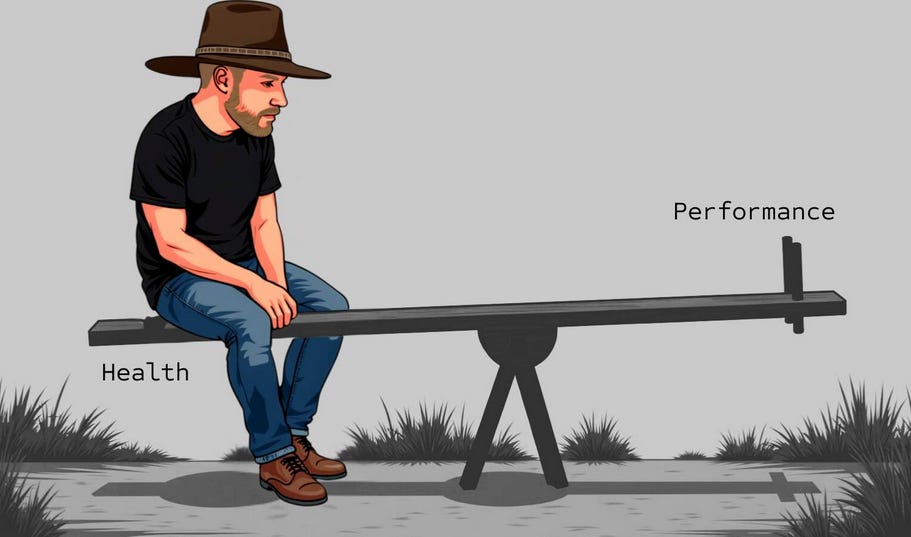
News flash: the weight and body composition that's best for your health is not the same that's best for your performance.
As counterintuitive as it might seem, the weight/body composition that produces the best blood work numbers, functional fitness (you know, doing real shit other than pedaling), and general life satisfaction/happiness 100% is not the same as the ideal weight/body composition to set a PR on your favorite climb.
In general, your body likes it when you're a bit heavier and dislikes it when you're a bit lighter. And you might ask, 'lighter than what, exactly?' and the answer to that is 'Your set point,‘ or the general weight at which your body hovers.
For example, personally speaking, my 'set point' is roughly 175 lbs. At 'race weight', I can get down to 165 lbs (with pain and suffering). I can also beef up to 190 if, I don't know, I want to appear more manly (also with pain and suffering). But, without really trying, I generally weigh about 175 lbs (I know, that's enormous for a cyclist!)
But, generally, my body prefers to be 190 much more than it likes being 165, probably because 99% of my ancestors spent most of their time trying not to starve to death. Your body probably works the same way.
What's my point? Understand that the body composition that produces the best performances on the bike probably isn't the same body composition that supports health.
Yes, Weight Matters in Cycling
Since we’re already talking about performance, I’m just going to come at the elephant in the room and claim, without a big windup or caveats, that yes, weight matters in cycling performance and, for the most part, being skinny is better than not being skinny.
Every year I listen to very serious people with lots of letters behind their name get onto podcasts and discuss body composition in cycling who grossly downplay the impact of weight on performance and somehow make weight loss out to be evil. I’ll say this again:
Weight matters in cycling performance, and being skinny is generally better than not being skinny.
Look, I don’t like that this is true, but since I respect you as an adult, I’m not going to lie to you and pretend it’s not a thing.
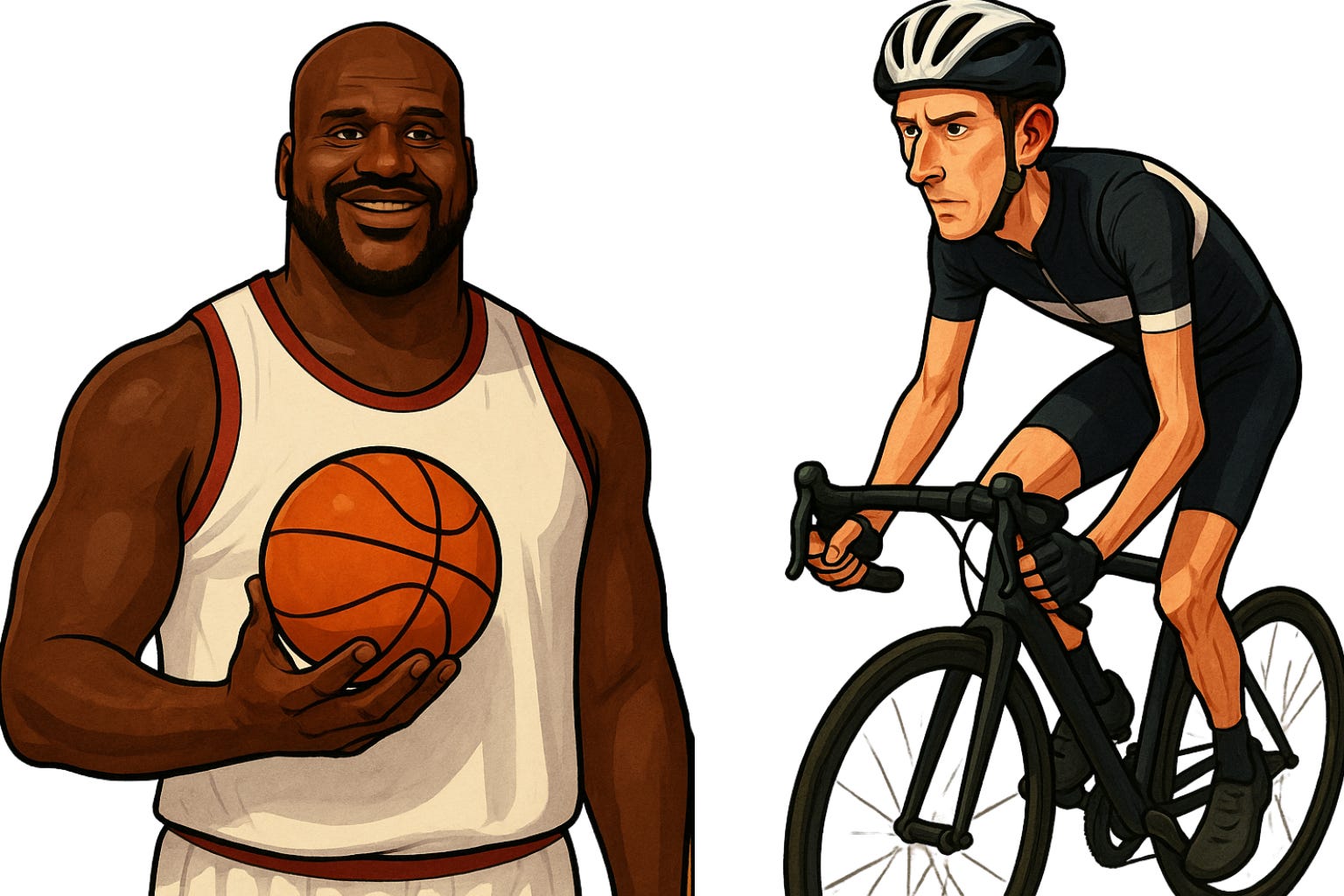
Why does skinny kill? For the same reasons that most NBA basketball players are over 6’7” - because there’s a phenotype that conveys an advantage in a given sport. Specifically, being skinny helps your:
Climbing - For every lb you lose, you gain about a second per kilometer uphill. If that sounds modest, understand that losing 5 lbs translates to climbing roughly 30 seconds faster on a short, 5km climb.
Acceleration - It is easier to change speeds with less mass to accelerate.
Fueling requirements - Less mass is easier to fuel than more mass.
Heat Tolerance - Bigger people suffer more in the heat.
Aerodynamics - In general, there’s a modest yet significant aerodynamic bump at a lower weight.
Again, everything I just said is only general and can often fall apart in the particular—i.e. There are always exceptions, and those exceptions are often so exceptional that they’re quite visible and thus overrepresented in the media, which misleads many people into thinking the advantages conveyed by phenotype don’t have any physiological underpinnings but arise abitrarily out of a backward, narrow sporting culture.
For example, Muggsy Bogues was 5’3” and had a wildly successful career in the NBA that gave short guys everyone hope but it didn’t change the fact he made the NBA despite being short, not because of it, whereas you could easily argue someone like Shaq was so dominate in the NBA not by virtue of his actually basketball skills (Shaqs free throw percentage was legendarily poor despite being constantly fouled) but because he was over 7’ tall and weighed enough to make The Mountain from game of Thrones feel average.
And so it is with cycling - being skinny generally convenys a performance advantage, so it should be no surprise that the best female cyclists in the world competing in the most prestigous cycling race primarily decided by their climbing ability on 1-2 stages in a well known week or two in late July would dust off their algebra skills, write down their threshold, write down the w/kg value they know they have to be able to sustain to win, and solve for weight.
You Don’t Want What You Think You Want
Why do some people say, “Never meet your heroes”? Because they will disappoint you.
I think the larger point in this entire controversy is that human beings can’t help but see extreme outliers and unthinkingly think, ‘I want to be like them.’
No, you don’t. You don’t want what you think you want. What you really want is a life without tradeoffs, a life where you get all the good things about being an extreme performance outlier and none of the bad things, but that fantasy only exists in the imagination, not reality.
Spread this like a respiratory virus across the internet so I can leave my day job, PLEASE!